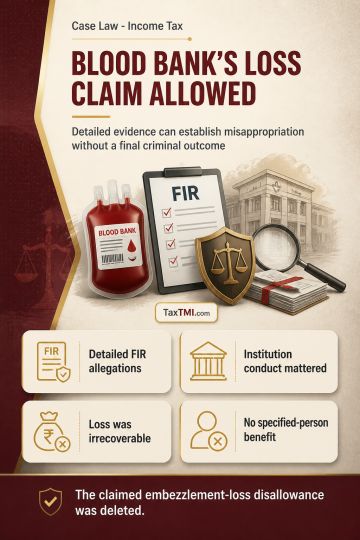
Embezzlement losses in charitable institutions remain allowable when misappropriation is established, irrecoverable, and not a specified-person benefi...
National long-distance undertaking status supports deduction where separately licensed infrastructure, resources, revenue, and expenditure establish c...
Agency reimbursement income follows contractual deposit-liability computation, while pending deposit collections do not constitute deemed-dividend loa...
Membership-consent thresholds for oppression petitions are satisfied by unchallenged voter-list consents, while unsupported forgery claims require pro...
Penalty levied u/s 271D for contravention of Section 269SS, which restricts cash transactions above a specified sum for immovable property. The key points are: The Assessing Officer (AO) failed to reconcile the assessment order and penalty order regarding the violation of Section 269SS. The penalty order should have referenced the AO's communication proposing the penalty initiation. The AO is required to record the satisfaction of Section 269SS violation and reference for penalty initiation in the assessment order itself. The interpretation of "specified sum" as a residuary term encompassing all cash transactions beyond a specified amount is incorrect. The amended Section 269SS applies to cash received as an advance for immovable property transactions, not to the final payment made at the time of registration and execution of the sale deed. The assessee had received cash against the sale of multiple registered sale deeds, not as an advance. Since the payment was made before the sub-registrar during registration, it does not violate Section 269SS. Consequently, the penalty levied u/s 271D is against the provisions of law and is quashed by the Appellate Tribunal.
Penalty levied u/s 271D for contravention of Section 269SS, which restricts cash transactions above a specified sum for immovable property. The key points are: The Assessing Officer (AO) failed to reconcile the assessment order and penalty order regarding the violation of Section 269SS. The penalty order should have referenced the AO's communication proposing the penalty initiation. The AO is required to record the satisfaction of Section 269SS violation and reference for penalty initiation in the assessment order itself. The interpretation of "specified sum" as a residuary term encompassing all cash transactions beyond a specified amount is incorrect. The amended Section 269SS applies to cash received as an advance for immovable property transactions, not to the final payment made at the time of registration and execution of the sale deed. The assessee had received cash against the sale of multiple registered sale deeds, not as an advance. Since the payment was made before the sub-registrar during registration, it does not violate Section 269SS. Consequently, the penalty levied u/s 271D is against the provisions of law and is quashed by the Appellate Tribunal.
Note: It is a system-generated summary and is for quick reference only.
 TaxTMI
  TaxTMI
 of 4881