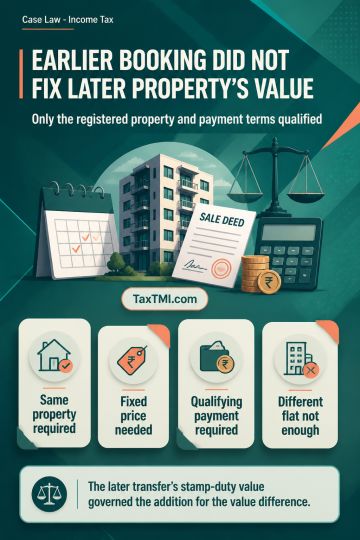
Agreement-date stamp valuation requires the same registered property, fixed consideration, and qualifying payment; an unrelated prior booking cannot a...
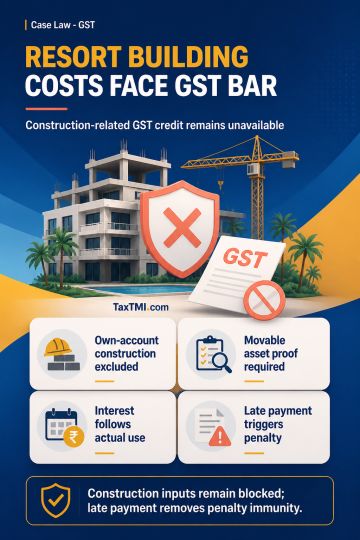
Blocked input tax credit for resort construction remains unavailable; interest follows actual utilisation, while delayed payment attracts statutory pe...
Page of 4891
Press 'Enter' after typing page number.
181 to 200 of 97809 Results
❮
❯
❯❯
0 / 200
Expand Note
Add to Folder
No Folders have been created
+
Are you sure you want to delete "My most important" ?
A legal challenge was raised regarding the requirement to pay the Social Welfare Surcharge (SWS) on imported goods when the basic customs and additional duty were exempted through a scrip. The court examined Section 110 of the Finance Act, 2018, which levies SWS at 10% on the aggregate of duties collected under the Customs Act. The petitioner argued that since no customs duty was paid due to the exemption, the SWS, being a percentage of the duty paid, should also be zero. The court agreed with this reasoning, distinguishing it from previous cases on NCCD where the issue was the absence of a notification for levy. The court held that upon obtaining an exemption, the liability to pay duty is discharged, and no duty collection follows the levy. Consequently, if the duty paid is zero, the SWS, calculated as a percentage of the duty paid, must also be zero. The court granted a declaration that the petitioner is not required to pay SWS on customs duty exempted under the scrip.
A legal challenge was raised regarding the requirement to pay the Social Welfare Surcharge (SWS) on imported goods when the basic customs and additional duty were exempted through a scrip. The court examined Section 110 of the Finance Act, 2018, which levies SWS at 10% on the aggregate of duties collected under the Customs Act. The petitioner argued that since no customs duty was paid due to the exemption, the SWS, being a percentage of the duty paid, should also be zero. The court agreed with this reasoning, distinguishing it from previous cases on NCCD where the issue was the absence of a notification for levy. The court held that upon obtaining an exemption, the liability to pay duty is discharged, and no duty collection follows the levy. Consequently, if the duty paid is zero, the SWS, calculated as a percentage of the duty paid, must also be zero. The court granted a declaration that the petitioner is not required to pay SWS on customs duty exempted under the scrip.
Note: It is a system-generated summary and is for quick reference only.
 TaxTMI
  TaxTMI
 of 4891