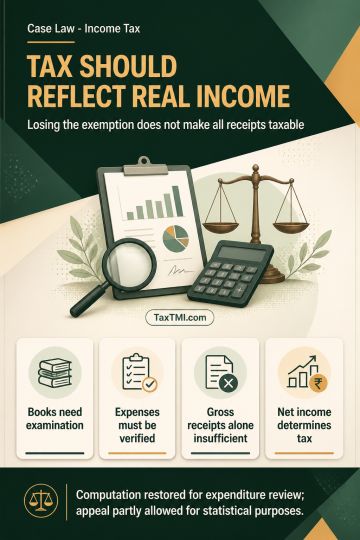
Third-party loose sheets require reliable nexus before supporting unexplained expenditure additions; presumptions do not establish payer identity or o...
TNMM comparability using audited accounts and working-capital adjustments can eliminate unwarranted transfer-pricing additions where verified margins ...
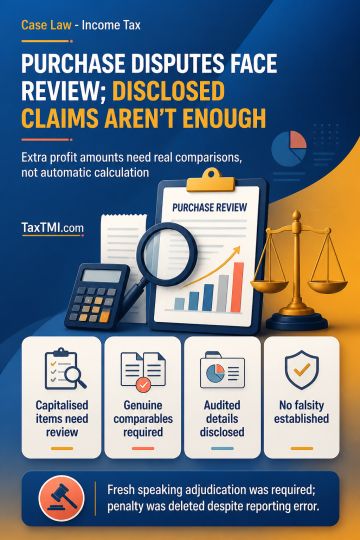
Gross-profit additions on disputed purchases require reasoned appellate determination; disclosed claims alone do not support inaccurate-particulars pe...
Limitation after transfer-pricing remand: fresh TPO reference did not extend the assessment deadline, rendering the consequential assessment time-barr...
Interim judicial restraint on tax deduction prevents default, while supporting reasonable cause and penalty deletion for foreign-leg LFC reimbursement...
Palmolein classification defeated the crude-oil concession; material misdeclaration sustained recovery and confiscation, while separate false-document...
The NCLAT held that disputes related to shareholder oppression or mismanagement under the Companies Act are distinct from the Insolvency and Bankruptcy Code (IBC) and fall outside its purview. As a special statute, the IBC prevails over the Companies Act pursuant to Section 238. The appellant's contention regarding resolution of the Company Petition u/ss 241 & 242 of the Companies Act before the CIRP petition was rejected. The NCLT order complied with the IBC provisions, and there was no pleading of pre-existing dispute. Equity shareholders, as owners, are beneficiaries when the company performs well but lose their capital in liquidation. While erstwhile directors can intervene and file appeals u/s 61, individual or majority shareholders cannot pursue derivative action. The appellant's argument that the definition of 'aggrieved person' u/s 61 should include any party whose interests are impacted was rejected, as a restrictive interpretation is warranted. The appellant, being a shareholder, is not an "aggrieved party" under the IBC and has no locus to file this appeal, leading to its dismissal.
The NCLAT held that disputes related to shareholder oppression or mismanagement under the Companies Act are distinct from the Insolvency and Bankruptcy Code (IBC) and fall outside its purview. As a special statute, the IBC prevails over the Companies Act pursuant to Section 238. The appellant's contention regarding resolution of the Company Petition u/ss 241 & 242 of the Companies Act before the CIRP petition was rejected. The NCLT order complied with the IBC provisions, and there was no pleading of pre-existing dispute. Equity shareholders, as owners, are beneficiaries when the company performs well but lose their capital in liquidation. While erstwhile directors can intervene and file appeals u/s 61, individual or majority shareholders cannot pursue derivative action. The appellant's argument that the definition of 'aggrieved person' u/s 61 should include any party whose interests are impacted was rejected, as a restrictive interpretation is warranted. The appellant, being a shareholder, is not an "aggrieved party" under the IBC and has no locus to file this appeal, leading to its dismissal.
Note: It is a system-generated summary and is for quick reference only.
 TaxTMI
  TaxTMI
 of 4891