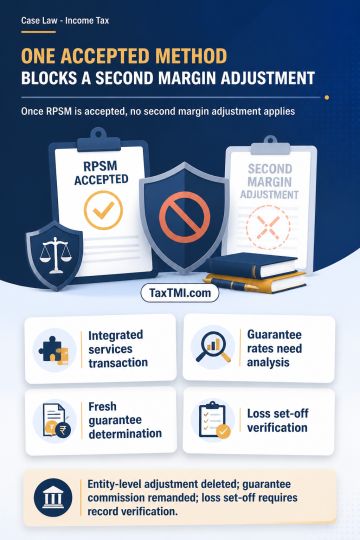
Form 26AS evidence requires successor-entity accounting verification after business transfer, while invoice-supported related-party advertising expend...
Money-laundering judgment timing requires awaiting the scheduled-offence decision despite continuation of the underlying trial where outcomes directly...
Accredited investor eligibility expands through securities-market exposure, while alternative investment fund disputes require prescribed resolution a...
Page of 4916
Press 'Enter' after typing page number.
41 to 60 of 98302 Results
❮
❯
❯❯
0 / 200
Expand Note
Add to Folder
No Folders have been created
+
Are you sure you want to delete "My most important" ?
Claim of second sale exemption and the imposition of penalty u/s 12(5)(iii). The High Court held that when the burden was on the dealer to prove the factum of second sale, the respondent had failed to discharge this burden by proving the actual first sale, which was a prerequisite for claiming the exemption. The Tribunal had erroneously shifted the burden from the dealer to the revenue. Relying on previous decisions, the High Court reiterated that the burden of proving an earlier taxable sale was on the assessee. Regarding the penalty u/s 12(5)(iii), the Court held that since the respondent had wilfully suppressed taxable turnover and failed to file returns, the Assessing Officer was justified in imposing the penalty, and the Tribunal's decision to delete the penalty was untenable. Consequently, the High Court set aside the Tribunal's order and restored the assessment order confirmed by the appellate authority.
Claim of second sale exemption and the imposition of penalty u/s 12(5)(iii). The High Court held that when the burden was on the dealer to prove the factum of second sale, the respondent had failed to discharge this burden by proving the actual first sale, which was a prerequisite for claiming the exemption. The Tribunal had erroneously shifted the burden from the dealer to the revenue. Relying on previous decisions, the High Court reiterated that the burden of proving an earlier taxable sale was on the assessee. Regarding the penalty u/s 12(5)(iii), the Court held that since the respondent had wilfully suppressed taxable turnover and failed to file returns, the Assessing Officer was justified in imposing the penalty, and the Tribunal's decision to delete the penalty was untenable. Consequently, the High Court set aside the Tribunal's order and restored the assessment order confirmed by the appellate authority.
Note: It is a system-generated summary and is for quick reference only.
 TaxTMI
 TaxTMI

 of 4916