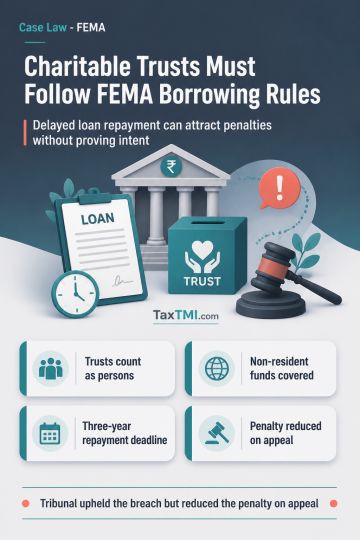
FEMA borrowing restrictions bind charitable trusts, and civil penalties apply without proving intent for delayed repayment of non-resident rupee loans...
Assessee received funds from four parties, which were not considered by the Assessing Officer (AO) during assessment proceedings u/s 147 read with Section 144. The Principal Commissioner of Income Tax (PCIT) cancelled the assessment framed by AO and directed to frame assessment afresh after verifying the funds received. However, the Appellate Tribunal held that the assessment framed by AO cannot be considered erroneous or prejudicial to the revenue's interest as the AO was unaware of these funds during assessment proceedings. Invoking Section 263 by PCIT is invalid as per the Supreme Court's judgment in Malabar Industries Limited case, which mandates that for invoking Section 263, the assessment order must be erroneous and prejudicial to revenue's interest. Assessee's appeal allowed.
Assessee received funds from four parties, which were not considered by the Assessing Officer (AO) during assessment proceedings u/s 147 read with Section 144. The Principal Commissioner of Income Tax (PCIT) cancelled the assessment framed by AO and directed to frame assessment afresh after verifying the funds received. However, the Appellate Tribunal held that the assessment framed by AO cannot be considered erroneous or prejudicial to the revenue's interest as the AO was unaware of these funds during assessment proceedings. Invoking Section 263 by PCIT is invalid as per the Supreme Court's judgment in Malabar Industries Limited case, which mandates that for invoking Section 263, the assessment order must be erroneous and prejudicial to revenue's interest. Assessee's appeal allowed.
Note: It is a system-generated summary and is for quick reference only.
 TaxTMI
  TaxTMI
 of 4878