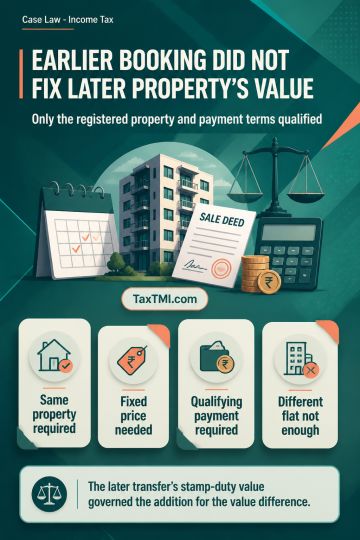
Agreement-date stamp valuation requires the same registered property, fixed consideration, and qualifying payment; an unrelated prior booking cannot a...
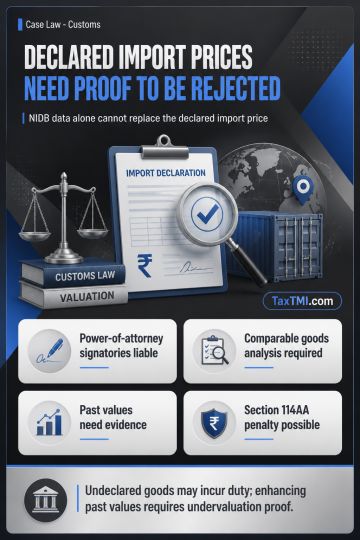
The case pertains to the imposition of a fine and penalty for the rejection of the declared value and redetermination of the value u/r 12 of the Customs Valuation (Determination of Price of Imported Goods) Rules, 2007. The goods were confiscated u/s 125 of the Customs Act, 1962, with an option to redeem them on payment of a fine of Rs. 3,25,000/- and a penalty of Rs. 1,50,000/- u/s 112(a) for rendering the goods liable for confiscation u/s 111. The Appellate Tribunal found that the issue involved a non-deliberate contravention of the law due to business exigencies, with no loss of revenue or deliberate intention to evade duty payment. While acknowledging that any breach of civil obligation under the Act is blameworthy, the Tribunal drew a distinction between a bona fide mistake and dishonest non-compliance when imposing a fine and penalty. Considering that the goods were not prohibited for import and the assessable value was determined at Rs. 6,54,349/-, the Tribunal found the initially imposed fine and penalty excessive and moderated them to a fine of Rs. 6,500/- and a penalty of Rs. 1,000/-.
The case pertains to the imposition of a fine and penalty for the rejection of the declared value and redetermination of the value u/r 12 of the Customs Valuation (Determination of Price of Imported Goods) Rules, 2007. The goods were confiscated u/s 125 of the Customs Act, 1962, with an option to redeem them on payment of a fine of Rs. 3,25,000/- and a penalty of Rs. 1,50,000/- u/s 112(a) for rendering the goods liable for confiscation u/s 111. The Appellate Tribunal found that the issue involved a non-deliberate contravention of the law due to business exigencies, with no loss of revenue or deliberate intention to evade duty payment. While acknowledging that any breach of civil obligation under the Act is blameworthy, the Tribunal drew a distinction between a bona fide mistake and dishonest non-compliance when imposing a fine and penalty. Considering that the goods were not prohibited for import and the assessable value was determined at Rs. 6,54,349/-, the Tribunal found the initially imposed fine and penalty excessive and moderated them to a fine of Rs. 6,500/- and a penalty of Rs. 1,000/-.
Note: It is a system-generated summary and is for quick reference only.
 TaxTMI
  TaxTMI
 of 4891