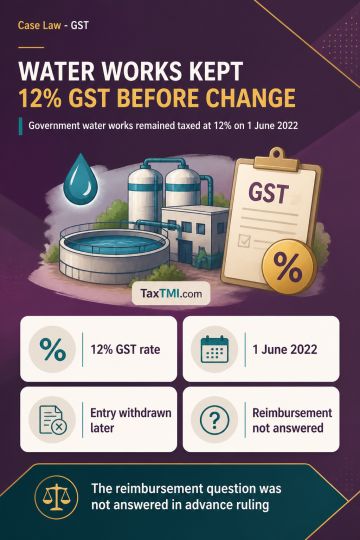
Government water works contract GST concession applied before its withdrawal, while contractual tax reimbursement claims lay outside advance-ruling sc...
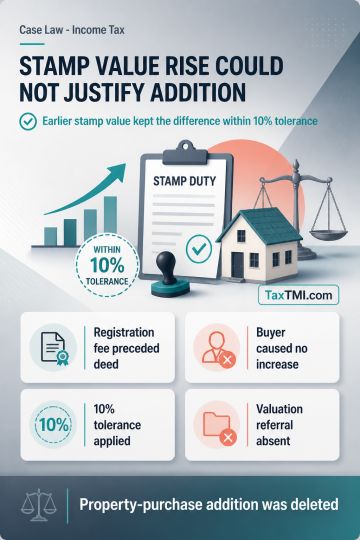
Stamp valuation increases after registration-fee payment led to deletion of property-purchase addition within tolerance and without valuation referral...
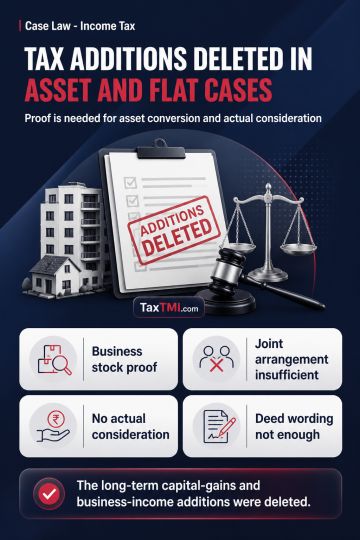
Capital Asset Conversion Requires Proven Business Stock Treatment; Paper Consideration in Spousal Flat Transfers Does Not Create Taxable Business Inco...
Page of 4881
Press 'Enter' after typing page number.
341 to 360 of 97618 Results
❮
❯
❯❯
0 / 200
Expand Note
Add to Folder
No Folders have been created
+
Are you sure you want to delete "My most important" ?
The High Court held that the Directorate General of Foreign Trade (DGFT) and its officials were unjustified in refusing to consider manually corrected shipping bills for the Merchandise Exports from India Scheme (MEIS) benefit, especially after Customs allowed amendments u/s 149 of the Customs Act. The Court emphasized that artificial intelligence cannot override human intelligence, and officials cannot abdicate responsibility or deny legitimate relief due to technological limitations. Technology should serve people, not create obstacles. The DGFT should have aligned its systems with the CBIC's Advisory No. 7 of 2023. The Court directed the DGFT to process the petitioner's application for MEIS scrips and release them within 15 days if eligible, as the amended shipping bill was electronically transmitted to DGFT. The Court stressed that human and artificial intelligence must work together to achieve ease of business, and technological glitches cannot deny benefits granted by law or government schemes.
The High Court held that the Directorate General of Foreign Trade (DGFT) and its officials were unjustified in refusing to consider manually corrected shipping bills for the Merchandise Exports from India Scheme (MEIS) benefit, especially after Customs allowed amendments u/s 149 of the Customs Act. The Court emphasized that artificial intelligence cannot override human intelligence, and officials cannot abdicate responsibility or deny legitimate relief due to technological limitations. Technology should serve people, not create obstacles. The DGFT should have aligned its systems with the CBIC's Advisory No. 7 of 2023. The Court directed the DGFT to process the petitioner's application for MEIS scrips and release them within 15 days if eligible, as the amended shipping bill was electronically transmitted to DGFT. The Court stressed that human and artificial intelligence must work together to achieve ease of business, and technological glitches cannot deny benefits granted by law or government schemes.
Note: It is a system-generated summary and is for quick reference only.
 TaxTMI
  TaxTMI
 of 4881