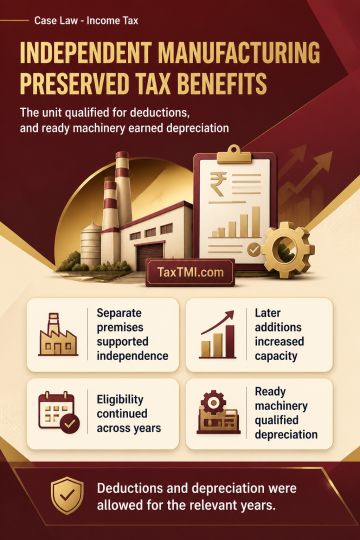
Independent manufacturing undertaking eligibility preserves Section 80IA/80IB deductions, while machinery kept ready for use qualifies for depreciatio...
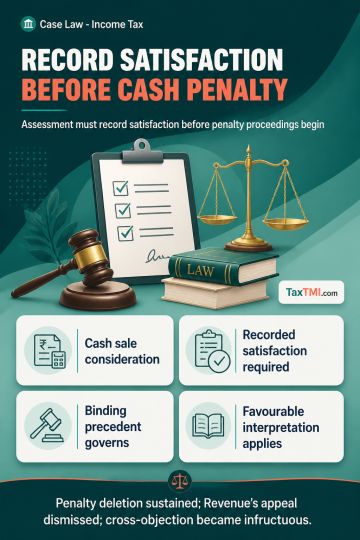
Assessing Officer Satisfaction Requirement Bars Penalty for Cash Receipt in Immovable-Property Sale Cases Where Initiation Lacks Recorded Satisfaction...
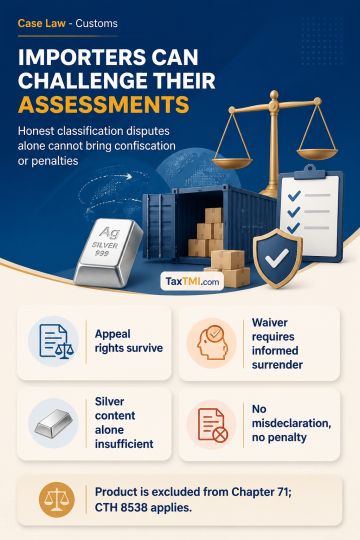
Self-assessed import entries remain appealable, while bona fide classification disputes without misdeclaration cannot justify confiscation or penaltie...
Actual-user customs exemption conditions permit turnkey project transfers when imported windmill components are exclusively used for installation and ...
Customs offence disqualification excludes civil contraventions, preventing refusal of a private bonded warehouse licence based solely on monetary pena...
The appellant had initially exported Indian tea to Netherlands, which was rejected and recalled to India. Upon re-importation, no DEPB claim was advanced. The goods were then imported against a Bill of Entry dated 17.03.2005 for re-export, claiming the benefit of Notification No.158/95. After processing, the goods were re-exported within the prescribed period under the said Notification, with proper declarations in the shipping bills. The allegation of non-compliance with procedures in identifying goods at the time of export or producing relevant reprocessing certificates was found unsustainable. The appellant was entitled to the benefit of Notification No.94/96-Cus. The Supreme Court's decision in Share Medical Care Vs. UOI established that an applicant is not barred from claiming the benefit of a notification at a later stage. Consequently, the impugned order demanding duty on the re-exported goods was set aside, and the appeal was allowed with consequential relief.
The appellant had initially exported Indian tea to Netherlands, which was rejected and recalled to India. Upon re-importation, no DEPB claim was advanced. The goods were then imported against a Bill of Entry dated 17.03.2005 for re-export, claiming the benefit of Notification No.158/95. After processing, the goods were re-exported within the prescribed period under the said Notification, with proper declarations in the shipping bills. The allegation of non-compliance with procedures in identifying goods at the time of export or producing relevant reprocessing certificates was found unsustainable. The appellant was entitled to the benefit of Notification No.94/96-Cus. The Supreme Court's decision in Share Medical Care Vs. UOI established that an applicant is not barred from claiming the benefit of a notification at a later stage. Consequently, the impugned order demanding duty on the re-exported goods was set aside, and the appeal was allowed with consequential relief.
Note: It is a system-generated summary and is for quick reference only.
 TaxTMI
  TaxTMI
 of 4891