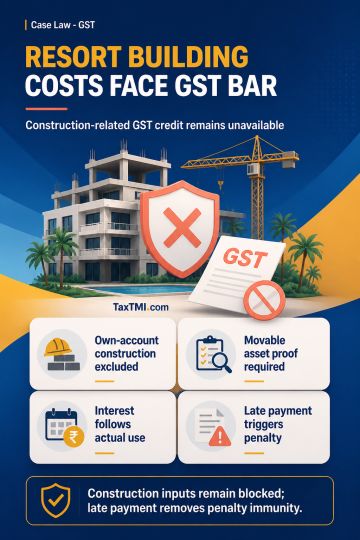
Blocked input tax credit for resort construction remains unavailable; interest follows actual utilisation, while delayed payment attracts statutory pe...
Duplicate PAN allocation requires record verification and deactivation reasons before assessment-related transactions can be attributed to an assessee...
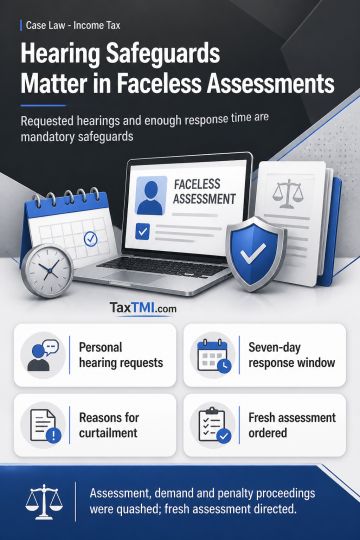
Faceless assessment safeguards require requested personal hearings and adequate final show-cause response time, failing which reassessment is required...
The High Court declined to grant interim relief, emphasizing that the amended writ petition raised numerous complex grounds which cannot be adjudicated fully at the interim stage. The Court clarified that a detailed examination of substantive grounds on merits would not be undertaken, and the assessment of contentions, particularly regarding merits, must necessarily be prima facie at this interim stage. Regarding the time limitation under Regulation 3(4) of the IBBI Regulations, the Court held that while the Regulation stipulates a strict time limit for filing a complaint, the critical issue is determining when the cause of action arose. In the present case, the allegations against the Petitioner in the Show Cause Notice dated 2nd April 2024 revolve around improper constitution and functioning of the Committee of Creditors (CoC), raising concerns about procedural irregularities and potential breaches of duty. The Court applied the principle of statutory interpretation u/s 13(2) of the General Clauses Act, 1897, to prima facie interpret the term "whole-time members" in Section 220(1) of the IBC to include a scenario with only one member, ensuring the disciplinary committee's effective operation. Ultimately, the Court found no ground to grant an interim stay on the impugned order and dismissed the present application.
The High Court declined to grant interim relief, emphasizing that the amended writ petition raised numerous complex grounds which cannot be adjudicated fully at the interim stage. The Court clarified that a detailed examination of substantive grounds on merits would not be undertaken, and the assessment of contentions, particularly regarding merits, must necessarily be prima facie at this interim stage. Regarding the time limitation under Regulation 3(4) of the IBBI Regulations, the Court held that while the Regulation stipulates a strict time limit for filing a complaint, the critical issue is determining when the cause of action arose. In the present case, the allegations against the Petitioner in the Show Cause Notice dated 2nd April 2024 revolve around improper constitution and functioning of the Committee of Creditors (CoC), raising concerns about procedural irregularities and potential breaches of duty. The Court applied the principle of statutory interpretation u/s 13(2) of the General Clauses Act, 1897, to prima facie interpret the term "whole-time members" in Section 220(1) of the IBC to include a scenario with only one member, ensuring the disciplinary committee's effective operation. Ultimately, the Court found no ground to grant an interim stay on the impugned order and dismissed the present application.
Note: It is a system-generated summary and is for quick reference only.
 TaxTMI
  TaxTMI