Reassessment for unreturned property sales survives where transfer information, non-filing, and unsupported exemption claims establish a prima facie l...
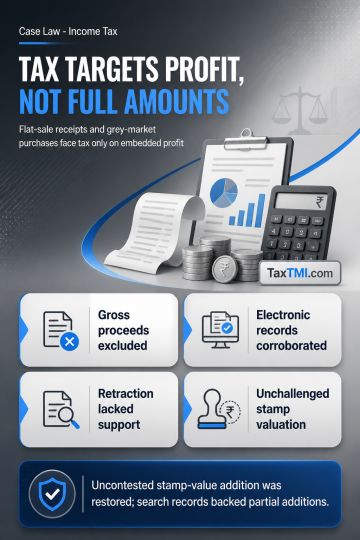
Profit-element taxation limits additions for unaccounted flat-sale receipts and grey-market purchases, while reliable search records support partial a...
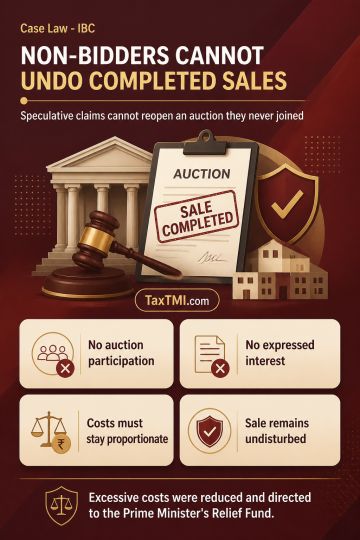
Non-participating bidders cannot disturb concluded liquidation sales on speculative prejudice, while costs for such challenges must remain proportiona...
Disallowance of CENVAT credit claimed by the appellant on various inputs and input services. The key points are: The credit was denied as the inputs and services did not qualify u/rs 2(k) and 2(l) of the CENVAT Credit Rules, 2004, due to the exclusion clauses. The decisions cited by the appellant were not relevant. The Bombay High Court and Supreme Court affirmed that goods/services excluded under the definition cannot be covered by referring to the main clause. Regarding construction materials, they fall under the exclusion clause for goods used for building construction. The appellant failed to prove the activities were for renovation/repair of an existing factory, as required for the inclusion clause. The credit on security and manpower services after production commenced was allowed, as it could not be attributed to factory setup. The demand needs re-determination, and the penalty u/r 15(1) was set aside, with the appeal partly allowed.
Disallowance of CENVAT credit claimed by the appellant on various inputs and input services. The key points are: The credit was denied as the inputs and services did not qualify u/rs 2(k) and 2(l) of the CENVAT Credit Rules, 2004, due to the exclusion clauses. The decisions cited by the appellant were not relevant. The Bombay High Court and Supreme Court affirmed that goods/services excluded under the definition cannot be covered by referring to the main clause. Regarding construction materials, they fall under the exclusion clause for goods used for building construction. The appellant failed to prove the activities were for renovation/repair of an existing factory, as required for the inclusion clause. The credit on security and manpower services after production commenced was allowed, as it could not be attributed to factory setup. The demand needs re-determination, and the penalty u/r 15(1) was set aside, with the appeal partly allowed.
Note: It is a system-generated summary and is for quick reference only.
 TaxTMI
  TaxTMI
 of 4891