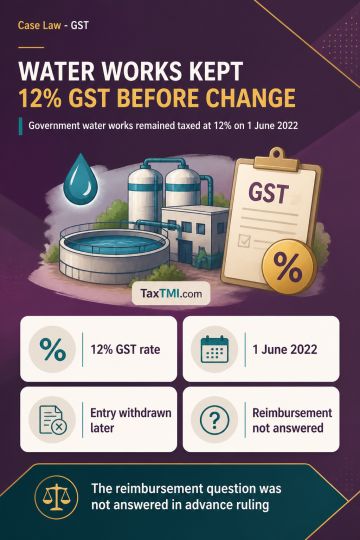
Government water works contract GST concession applied before its withdrawal, while contractual tax reimbursement claims lay outside advance-ruling sc...
The case deals with the applicability of Section 54EC of the Income Tax Act, which provides exemption from capital gains tax if the gains are invested in specified bonds within the prescribed time limit. The key points are: The assessee received advances from purchasers for a property sale and initially invested these advances in mutual funds. Subsequently, the maturity proceeds from the mutual funds were used to invest in bonds u/s 54EC. The Revenue contended that the investment in bonds should be made directly from the sale proceeds and not from funds derived from other sources like mutual funds. The Tribunal held that the source of investment in bonds was clearly traceable to the advances received from purchasers, establishing a direct nexus. The mere routing of funds through mutual funds does not negate the claim u/s 54EC, as no other funds were available with the assessee. The Tribunal relied on the Delhi High Court's judgment in Bhupendra Kumar Bhaumik's case and the Supreme Court's ratio in Malabar Industrial Co. Ltd., which supported the assessee's claim. The provisions of Section 54EC were interpreted in line with the erstwhile Section 54E, as the scheme of capital gains exemption envisaged a seamless continuation. Consequently, the Tribunal ruled in favor of the assessee, holding that there was no error in the Assessing Officer's order warranting intervention u/s.
The case deals with the applicability of Section 54EC of the Income Tax Act, which provides exemption from capital gains tax if the gains are invested in specified bonds within the prescribed time limit. The key points are: The assessee received advances from purchasers for a property sale and initially invested these advances in mutual funds. Subsequently, the maturity proceeds from the mutual funds were used to invest in bonds u/s 54EC. The Revenue contended that the investment in bonds should be made directly from the sale proceeds and not from funds derived from other sources like mutual funds. The Tribunal held that the source of investment in bonds was clearly traceable to the advances received from purchasers, establishing a direct nexus. The mere routing of funds through mutual funds does not negate the claim u/s 54EC, as no other funds were available with the assessee. The Tribunal relied on the Delhi High Court's judgment in Bhupendra Kumar Bhaumik's case and the Supreme Court's ratio in Malabar Industrial Co. Ltd., which supported the assessee's claim. The provisions of Section 54EC were interpreted in line with the erstwhile Section 54E, as the scheme of capital gains exemption envisaged a seamless continuation. Consequently, the Tribunal ruled in favor of the assessee, holding that there was no error in the Assessing Officer's order warranting intervention u/s.
Note: It is a system-generated summary and is for quick reference only.
 TaxTMI
  TaxTMI
 of 4888