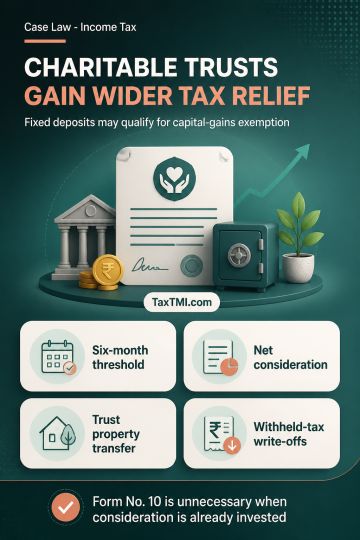
Capital-gains exemption for charitable trusts extends to qualifying fixed deposits, while unrecoverable TDS write-offs may constitute income applicati...
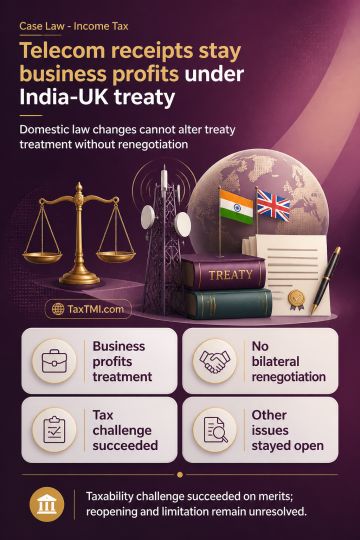
India-UK treaty characterisation of telecom-service receipts as business profits withstands unilateral domestic-law amendments for Indian tax purposes...
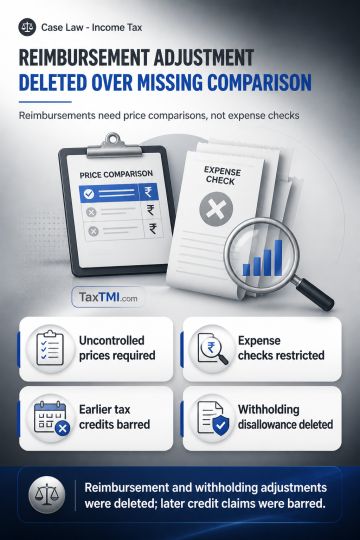
Transfer-pricing reimbursement adjustments require uncontrolled comparables and cannot become expense-genuineness reviews, resulting in deletion of th...
Food import sampling requirements support provisional release where unseized consignments conform to standards and raw areca classification is unestab...
Page of 4891
Press 'Enter' after typing page number.
481 to 500 of 97809 Results
❮
❯
❯❯
0 / 200
Expand Note
Add to Folder
No Folders have been created
+
Are you sure you want to delete "My most important" ?
The National Company Law Appellate Tribunal (NCLAT) has remanded the case back to the Adjudicating Authority (AA) to examine and decide the issues in a comprehensive manner, including the application of the appellant in I.A. No. 1412 of 2023, preferably within four weeks. The NCLAT held that there is an absolute bar on recovery of any property occupied or possessed by the Corporate Debtor u/s 14(1)(d) of the Insolvency and Bankruptcy Code. The AA had passed a non-speaking order merely based on the consent of the Resolution Professional (RP) to release the property, without examining the maintainability of such applications by the owner/lessor in view of Section 14(1)(d). The Committee of Creditors (CoC) did not appear to have taken a final decision with proper voting regarding the vacation of the registered office. The RP's decision to release the property was his own and not confirmed by the CoC. The NCLAT found that the AA should have first examined whether it is possible to allow such applications in view of the express provisions of Section 14(1)(d), even if supported by the CoC. The appeal was allowed.
The National Company Law Appellate Tribunal (NCLAT) has remanded the case back to the Adjudicating Authority (AA) to examine and decide the issues in a comprehensive manner, including the application of the appellant in I.A. No. 1412 of 2023, preferably within four weeks. The NCLAT held that there is an absolute bar on recovery of any property occupied or possessed by the Corporate Debtor u/s 14(1)(d) of the Insolvency and Bankruptcy Code. The AA had passed a non-speaking order merely based on the consent of the Resolution Professional (RP) to release the property, without examining the maintainability of such applications by the owner/lessor in view of Section 14(1)(d). The Committee of Creditors (CoC) did not appear to have taken a final decision with proper voting regarding the vacation of the registered office. The RP's decision to release the property was his own and not confirmed by the CoC. The NCLAT found that the AA should have first examined whether it is possible to allow such applications in view of the express provisions of Section 14(1)(d), even if supported by the CoC. The appeal was allowed.
Note: It is a system-generated summary and is for quick reference only.
 TaxTMI
  TaxTMI
 of 4891