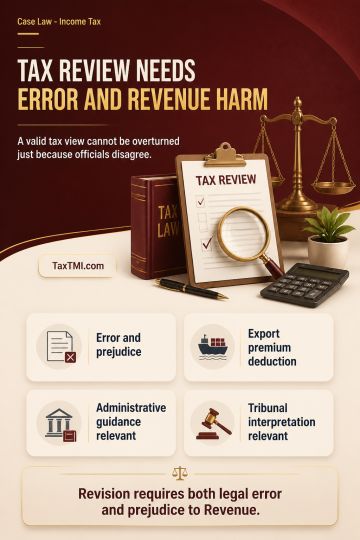
Revisional jurisdiction over export quota premium deductions requires both error and Revenue prejudice; a permissible assessment view cannot be displa...
Final benami adjudication bars contradictory tax-evasion prosecution where settlement findings confirm full disclosure and cooperation without conceal...
Faceless assessment and registration procedures are updated through electronic communication, revised recovery rules, extended deadlines, and replacem...
Risk-based selective vessel boarding requires accurate declarations and preserves master and agent liability where physical inspections are not select...
Interpretation of Section 141 of the Negotiable Instruments Act, which deals with vicarious liability for offenses committed by companies u/s 138 (dishonor of cheques). The key points are: Section 141 is a penal provision that must be strictly construed. Liability under this section depends on the role played by the person in the company's affairs, not merely their designation. To attract liability, the person must have been in charge of and responsible for the company's conduct at the time of the offense's commission. Merely being a director or having some association with the company is insufficient. The complaint must specify the accused's role and how they were responsible for the company's conduct. In this case, the petitioner had resigned as director before the relevant events (issuance, dishonor, and notice of dishonor of cheque) occurred. Therefore, the petitioner cannot be held vicariously liable u/s 141 as they were not in charge or responsible for the company's conduct during the commission of the offense.
Interpretation of Section 141 of the Negotiable Instruments Act, which deals with vicarious liability for offenses committed by companies u/s 138 (dishonor of cheques). The key points are: Section 141 is a penal provision that must be strictly construed. Liability under this section depends on the role played by the person in the company's affairs, not merely their designation. To attract liability, the person must have been in charge of and responsible for the company's conduct at the time of the offense's commission. Merely being a director or having some association with the company is insufficient. The complaint must specify the accused's role and how they were responsible for the company's conduct. In this case, the petitioner had resigned as director before the relevant events (issuance, dishonor, and notice of dishonor of cheque) occurred. Therefore, the petitioner cannot be held vicariously liable u/s 141 as they were not in charge or responsible for the company's conduct during the commission of the offense.
Note: It is a system-generated summary and is for quick reference only.
 TaxTMI
  TaxTMI
 of 4897