Form 26AS evidence requires successor-entity accounting verification after business transfer, while invoice-supported related-party advertising expend...
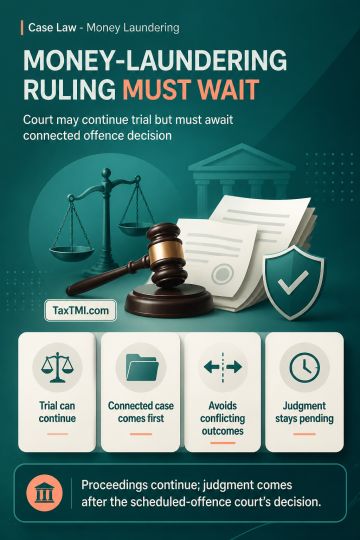
Money-laundering judgment timing requires awaiting the scheduled-offence decision despite continuation of the underlying trial where outcomes directly...
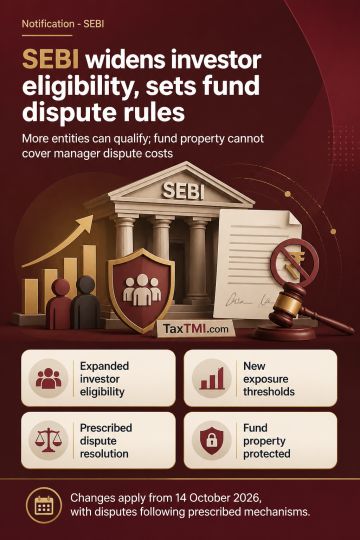
Accredited investor eligibility expands through securities-market exposure, while alternative investment fund disputes require prescribed resolution a...
Customs Assessment Portal centralises classification and valuation guidance to support consistent, transparent and informed compliance across stakehol...
Page of 4918
Press 'Enter' after typing page number.
101 to 120 of 98359 Results
❮
❯
❯❯
0 / 200
Expand Note
Add to Folder
No Folders have been created
+
Are you sure you want to delete "My most important" ?
The court quashed the order blocking the Electronic Credit Ledger (ECL) of the petitioner u/r 86A of the Central Goods and Services Tax Rules, 2017. The respondents did not provide a pre-decisional hearing to the petitioner, nor did the impugned order contain cogent reasons to believe that blocking the ECL was necessary, violating principles of natural justice. The court relied on the K-9-Enterprises case, where it was held that the mandatory requirements of Rule 86A were not fulfilled, and the respondents could not rely on the satisfaction of another officer. The impugned order merely stated that the supplier was found non-existent or not conducting business, without providing independent or cogent reasons. Consequently, the impugned orders were quashed for lack of valid reasons and violation of principles of natural justice.
The court quashed the order blocking the Electronic Credit Ledger (ECL) of the petitioner u/r 86A of the Central Goods and Services Tax Rules, 2017. The respondents did not provide a pre-decisional hearing to the petitioner, nor did the impugned order contain cogent reasons to believe that blocking the ECL was necessary, violating principles of natural justice. The court relied on the K-9-Enterprises case, where it was held that the mandatory requirements of Rule 86A were not fulfilled, and the respondents could not rely on the satisfaction of another officer. The impugned order merely stated that the supplier was found non-existent or not conducting business, without providing independent or cogent reasons. Consequently, the impugned orders were quashed for lack of valid reasons and violation of principles of natural justice.
Note: It is a system-generated summary and is for quick reference only.
 TaxTMI
  TaxTMI
 of 4918