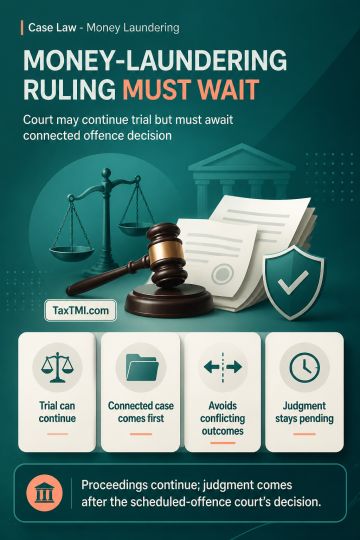
Money-laundering judgment timing requires awaiting the scheduled-offence decision despite continuation of the underlying trial where outcomes directly...
Accredited investor eligibility expands through securities-market exposure, while alternative investment fund disputes require prescribed resolution a...
Customs Assessment Portal centralises classification and valuation guidance to support consistent, transparent and informed compliance across stakehol...
The principles of independence and impartiality of arbitral tribunals under the Arbitration and Conciliation Act 1996 were evaluated in relation to party autonomy. Unilateral appointment of sole arbitrator or curation of panel for other party's selection was examined. The majority held that equal treatment applies at appointment stage, prohibiting unilateral appointments or curated panels by one party. Such clauses in public-private contracts violate Article 14. Waiver u/s 12(5) is possible post-disputes. The ruling applies prospectively to three-member tribunals. A minority view permitted unilateral appointments if arbitrators meet eligibility criteria, limiting judicial intervention at appointment stage. The interplay between contractual autonomy and statutory duty to constitute independent tribunals was analyzed, with the latter being a non-derogable public policy under the Contract Act. Courts must scrutinize agreements to ensure compliance with this requirement while respecting party autonomy.
The principles of independence and impartiality of arbitral tribunals under the Arbitration and Conciliation Act 1996 were evaluated in relation to party autonomy. Unilateral appointment of sole arbitrator or curation of panel for other party's selection was examined. The majority held that equal treatment applies at appointment stage, prohibiting unilateral appointments or curated panels by one party. Such clauses in public-private contracts violate Article 14. Waiver u/s 12(5) is possible post-disputes. The ruling applies prospectively to three-member tribunals. A minority view permitted unilateral appointments if arbitrators meet eligibility criteria, limiting judicial intervention at appointment stage. The interplay between contractual autonomy and statutory duty to constitute independent tribunals was analyzed, with the latter being a non-derogable public policy under the Contract Act. Courts must scrutinize agreements to ensure compliance with this requirement while respecting party autonomy.
Note: It is a system-generated summary and is for quick reference only.
 TaxTMI
  TaxTMI
 of 4920