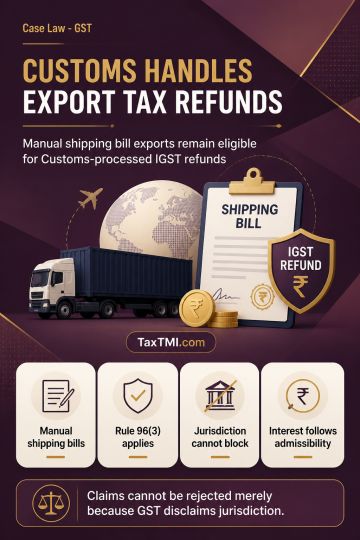
Customs Assessment Portal centralises classification and valuation guidance to support consistent, transparent and informed compliance across stakehol...
GST refunds for cancelled air tickets remain available when passenger reimbursements defeat unjust enrichment and credit-note adjustment is unavailabl...
Disallowing interest expenditure claimed u/s 36(1)(iii) when the assessee firm has interest-free funds and the amount overdrawn by partners. The Tribunal held that since the assessee firm had interest-free funds sufficient to cover the amounts overdrawn by partners, as evident from audited accounts, the disallowance of interest expenditure by the Assessing Officer was unjustified. The Tribunal relied on decisions of the Bombay High Court and its own coordinate Bench, which established that if an assessee has sufficient interest-free funds and advances are made without charging interest, disallowance u/s 36(1)(iii) on such advances for notional interest is not permissible. The Tribunal found no merit in the Revenue's appeal, concluding that the Assessing Officer's adverse inference was a misreading of facts contrary to documented evidence provided by the assessee.
Disallowing interest expenditure claimed u/s 36(1)(iii) when the assessee firm has interest-free funds and the amount overdrawn by partners. The Tribunal held that since the assessee firm had interest-free funds sufficient to cover the amounts overdrawn by partners, as evident from audited accounts, the disallowance of interest expenditure by the Assessing Officer was unjustified. The Tribunal relied on decisions of the Bombay High Court and its own coordinate Bench, which established that if an assessee has sufficient interest-free funds and advances are made without charging interest, disallowance u/s 36(1)(iii) on such advances for notional interest is not permissible. The Tribunal found no merit in the Revenue's appeal, concluding that the Assessing Officer's adverse inference was a misreading of facts contrary to documented evidence provided by the assessee.
Note: It is a system-generated summary and is for quick reference only.
 TaxTMI
  TaxTMI
 of 4916