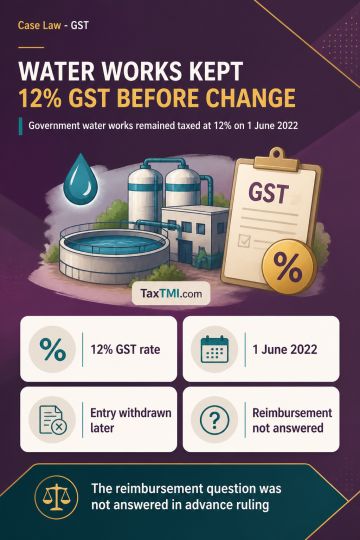
Government water works contract GST concession applied before its withdrawal, while contractual tax reimbursement claims lay outside advance-ruling sc...
Validity of reassessment proceedings u/s 147, the requirement of fresh tangible material for reopening assessment, and the disallowance of expenditure incurred on DAP, production, and translation expenses. The court held that the reasons provided by the Assessing Officer (AO) failed to demonstrate the assessee's failure to disclose fully and truly, rendering the reassessment exercise nugatory. The court observed that the purported reasons only demonstrated a change of opinion, which cannot form the basis for reopening the assessment. The court also noted that even if the AO's argument of allowing expenses due to a mistake or without verification is accepted, the appropriate remedy would lie u/s 263. Consequently, the essential ingredient for reopening the assessment beyond four years was not satisfied, making the reassessment proceedings bad in law. Additionally, the court highlighted that the details regarding the expenses were placed before the AO in the previous assessment years, and the claim for deductibility was allowed, attaining finality. Since identical expenditure was claimed year after year without disallowance, the basis for "reasons to believe" did not survive anymore. The decision was in favor of the assessee.
Validity of reassessment proceedings u/s 147, the requirement of fresh tangible material for reopening assessment, and the disallowance of expenditure incurred on DAP, production, and translation expenses. The court held that the reasons provided by the Assessing Officer (AO) failed to demonstrate the assessee's failure to disclose fully and truly, rendering the reassessment exercise nugatory. The court observed that the purported reasons only demonstrated a change of opinion, which cannot form the basis for reopening the assessment. The court also noted that even if the AO's argument of allowing expenses due to a mistake or without verification is accepted, the appropriate remedy would lie u/s 263. Consequently, the essential ingredient for reopening the assessment beyond four years was not satisfied, making the reassessment proceedings bad in law. Additionally, the court highlighted that the details regarding the expenses were placed before the AO in the previous assessment years, and the claim for deductibility was allowed, attaining finality. Since identical expenditure was claimed year after year without disallowance, the basis for "reasons to believe" did not survive anymore. The decision was in favor of the assessee.
Note: It is a system-generated summary and is for quick reference only.
 TaxTMI
  TaxTMI
 of 4886