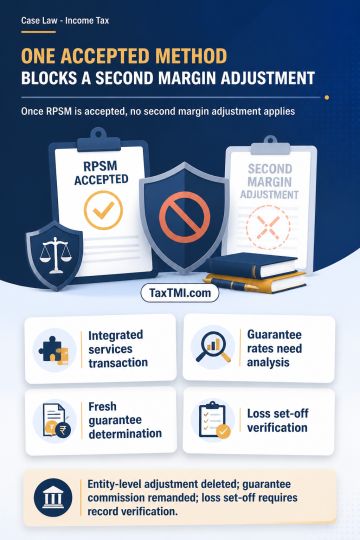
Form 26AS evidence requires successor-entity accounting verification after business transfer, while invoice-supported related-party advertising expend...
Money-laundering judgment timing requires awaiting the scheduled-offence decision despite continuation of the underlying trial where outcomes directly...
Accredited investor eligibility expands through securities-market exposure, while alternative investment fund disputes require prescribed resolution a...
Page of 4916
Press 'Enter' after typing page number.
41 to 60 of 98302 Results
❮
❯
❯❯
0 / 200
Expand Note
Add to Folder
No Folders have been created
+
Are you sure you want to delete "My most important" ?
The case pertains to the levy of interest u/s 234C for failure on the part of the payer to deduct tax deducted at source (TDS) u/ss 196D and 194LD. The key points are: Tax due on returned income means the tax chargeable on the total income declared in the return, reduced by the TDS amount. The advance tax is reduced by the TDS amount, meaning the assessee is not required to pay advance tax to that extent. Since the payers failed to deduct TDS, the assessee paid the full tax. Therefore, interest u/s 234C cannot be levied on the assessee for the payers' fault. The Bombay High Court in Ngc Network Asia LLC held that when the payer fails to deduct TDS, no interest u/s 234B can be imposed on the payee assessee. It is not a case of deferment in payment of advance tax u/s 234C since the assessee discharged the tax liability. Thus, the Appellate Tribunal directed the Assessing Officer to delete the impugned addition of interest u/s 234C, deciding in favor of the assessee.
The case pertains to the levy of interest u/s 234C for failure on the part of the payer to deduct tax deducted at source (TDS) u/ss 196D and 194LD. The key points are: Tax due on returned income means the tax chargeable on the total income declared in the return, reduced by the TDS amount. The advance tax is reduced by the TDS amount, meaning the assessee is not required to pay advance tax to that extent. Since the payers failed to deduct TDS, the assessee paid the full tax. Therefore, interest u/s 234C cannot be levied on the assessee for the payers' fault. The Bombay High Court in Ngc Network Asia LLC held that when the payer fails to deduct TDS, no interest u/s 234B can be imposed on the payee assessee. It is not a case of deferment in payment of advance tax u/s 234C since the assessee discharged the tax liability. Thus, the Appellate Tribunal directed the Assessing Officer to delete the impugned addition of interest u/s 234C, deciding in favor of the assessee.
Note: It is a system-generated summary and is for quick reference only.
 TaxTMI
 TaxTMI

 of 4916