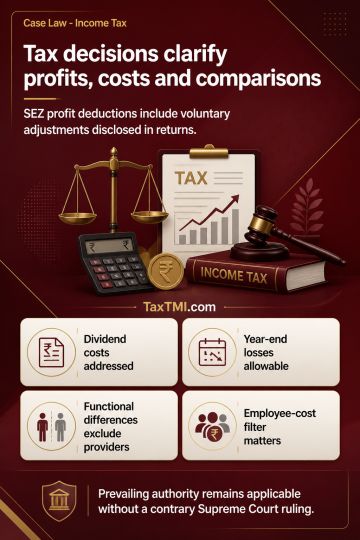
SEZ-unit profit deduction covers voluntary transfer-pricing adjustments, while exempt-income costs, foreign-exchange loss and ITeS comparables are exa...
The case pertains to the classification of imported goods declared as "Spare Parts of E-rickshaw" by the respondent. The lower authority classified the goods under CTH 8703.80, covering vehicles propelled through a motor powered by a battery. However, the Tribunal held that the imported goods, if assembled, would not provide the basic function of propulsion required for classification under CTH 8703.80. Referring to the Twinkle Tradecom case, the Tribunal stated that for a machine or vehicle's essential characteristics, the parts involved in manufacturing should fulfill the basic principle of that vehicle or machine. Since the mis-declaration of description, classification, and value alleged by the Department was not established, the Tribunal ruled that the imported goods were not liable for confiscation. The Revenue's appeal was dismissed, and the enhancement of value without following due process, the Customs Valuation Rules, 2007, and principles of natural justice was deemed unsustainable.
The case pertains to the classification of imported goods declared as "Spare Parts of E-rickshaw" by the respondent. The lower authority classified the goods under CTH 8703.80, covering vehicles propelled through a motor powered by a battery. However, the Tribunal held that the imported goods, if assembled, would not provide the basic function of propulsion required for classification under CTH 8703.80. Referring to the Twinkle Tradecom case, the Tribunal stated that for a machine or vehicle's essential characteristics, the parts involved in manufacturing should fulfill the basic principle of that vehicle or machine. Since the mis-declaration of description, classification, and value alleged by the Department was not established, the Tribunal ruled that the imported goods were not liable for confiscation. The Revenue's appeal was dismissed, and the enhancement of value without following due process, the Customs Valuation Rules, 2007, and principles of natural justice was deemed unsustainable.
Note: It is a system-generated summary and is for quick reference only.
 TaxTMI
  TaxTMI
 of 4881