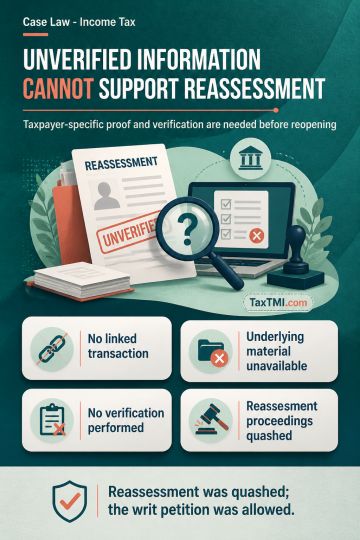
Unverified Insight Portal Information Cannot Justify Reassessment Without a Verified Taxpayer-Specific Income-Escape Nexus or Demonstrated Application...
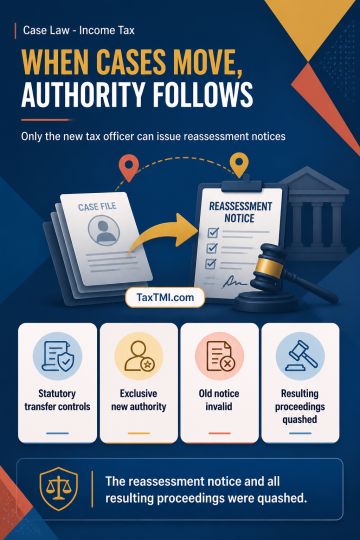
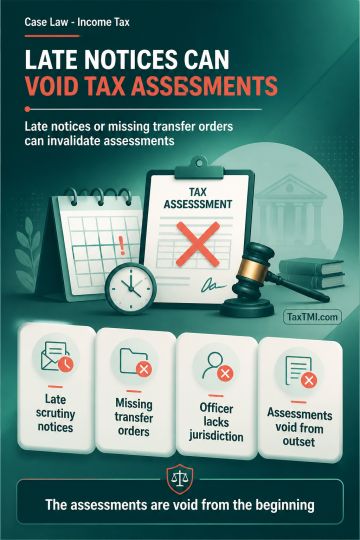
Assessing Officer jurisdiction after statutory transfer invalidates reassessment notices issued by transferor officers and nullifies resulting proceed...
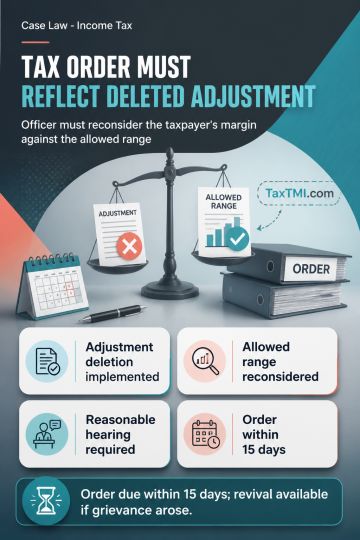
Consequential appeal-effect orders must implement rectification deleting working-capital adjustments and reconsider the resulting arm's-length range c...
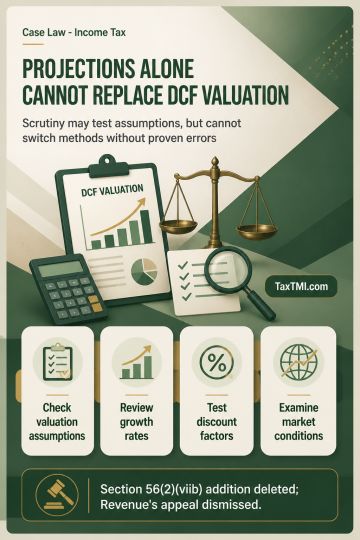
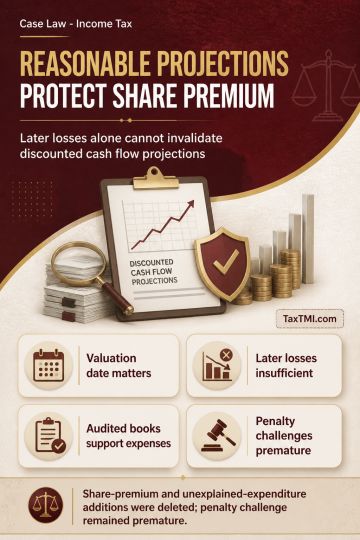
Discounted cash flow valuation protects share premium where projections are reasonable, while audited book expenses defeat unexplained-expenditure add...
Section 54 construction relief survives pre-transfer commencement when completion occurs within the statutory period, excluding ineligible spouse-owne...
The High Court examined the validity of reassessment notices issued u/s 148 of the Income Tax Act by the Joint Assistant Commissioner (JAC) in light of the Faceless Assessment Scheme formulated u/s 151A. The key points are: The Act allows reassessment based on information from Risk Management System (RMS), audit objections, information from other countries, information u/s 135A schemes, or orders of Tribunals/Courts. The JAC can form an opinion based on such information and initiate reassessment proceedings u/s 148A. Information gathered during searches/surveys is also deemed as "information" for reassessment purposes under Explanation 2 to Section 148. The Faceless Assessment Scheme segregates the initiation of reassessment proceedings by the JAC from the actual faceless assessment by the National Faceless Assessment Centre (NFAC). The JAC examines information from RMS/other sources and forms an opinion on reassessment, while the NFAC conducts the actual faceless assessment through automated allocation. Rendering the JAC's powers redundant under the faceless scheme would conflict with beneficial construction principles and undermine provisions for comprehensive data analysis and informed decision-making. The High Court upheld the validity of notices issued by the JAC, observing a harmonious distribution of functions between the JAC and NF.
The High Court examined the validity of reassessment notices issued u/s 148 of the Income Tax Act by the Joint Assistant Commissioner (JAC) in light of the Faceless Assessment Scheme formulated u/s 151A. The key points are: The Act allows reassessment based on information from Risk Management System (RMS), audit objections, information from other countries, information u/s 135A schemes, or orders of Tribunals/Courts. The JAC can form an opinion based on such information and initiate reassessment proceedings u/s 148A. Information gathered during searches/surveys is also deemed as "information" for reassessment purposes under Explanation 2 to Section 148. The Faceless Assessment Scheme segregates the initiation of reassessment proceedings by the JAC from the actual faceless assessment by the National Faceless Assessment Centre (NFAC). The JAC examines information from RMS/other sources and forms an opinion on reassessment, while the NFAC conducts the actual faceless assessment through automated allocation. Rendering the JAC's powers redundant under the faceless scheme would conflict with beneficial construction principles and undermine provisions for comprehensive data analysis and informed decision-making. The High Court upheld the validity of notices issued by the JAC, observing a harmonious distribution of functions between the JAC and NF.
Note: It is a system-generated summary and is for quick reference only.
 TaxTMI
  TaxTMI
 of 4881