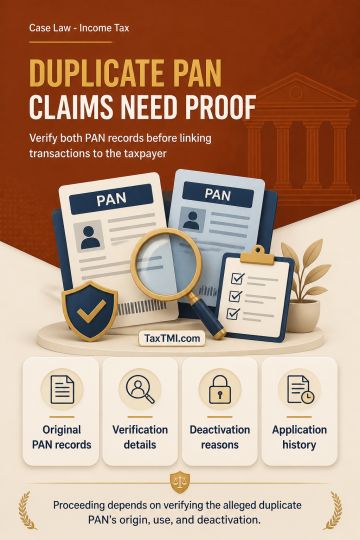
Duplicate PAN allocation requires record verification and deactivation reasons before assessment-related transactions can be attributed to an assessee...
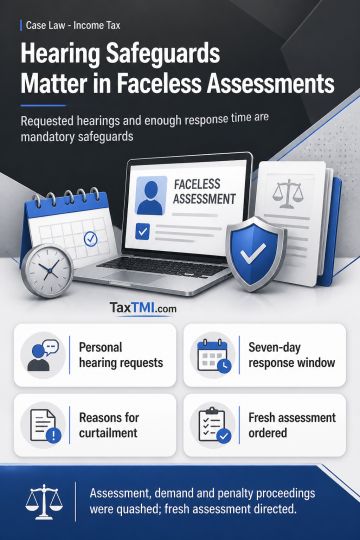
Faceless assessment safeguards require requested personal hearings and adequate final show-cause response time, failing which reassessment is required...
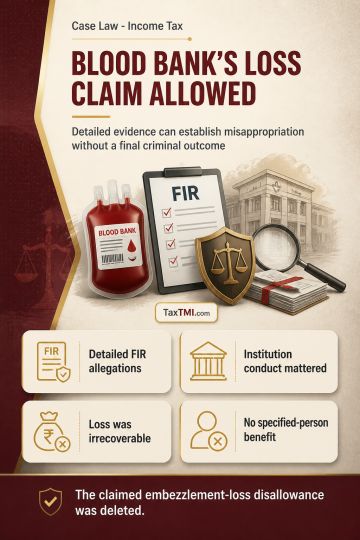
Embezzlement losses in charitable institutions remain allowable when misappropriation is established, irrecoverable, and not a specified-person benefi...
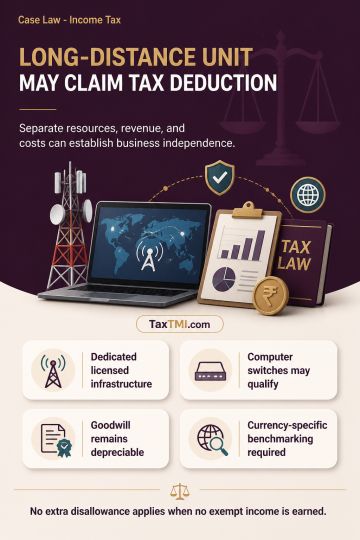
National long-distance undertaking status supports deduction where separately licensed infrastructure, resources, revenue, and expenditure establish c...
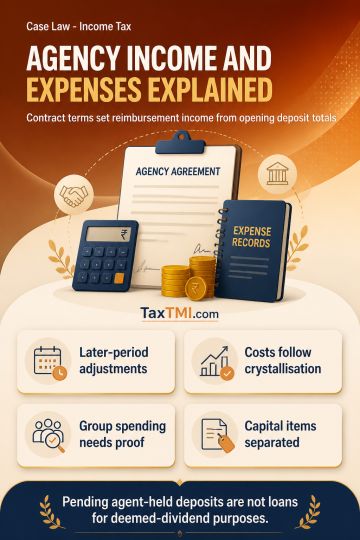
Agency reimbursement income follows contractual deposit-liability computation, while pending deposit collections do not constitute deemed-dividend loa...
Page of 4883
Press 'Enter' after typing page number.
41 to 60 of 97649 Results
❮
❯
❯❯
0 / 200
Expand Note
Add to Folder
No Folders have been created
+
Are you sure you want to delete "My most important" ?
The appellant is not liable to pay service tax on supply of water by the Government of Odisha, as the issue has been settled by the Tribunal's decision in a previous case. The agreement between the appellant and the government is for supply of water, for which charges are paid based on volume drawn, and it is not a case of assignment of right to use natural resources. Regarding re-availment of Cenvat credit subsequent to change of option u/r 6(3) of the Cenvat Credit Rules, 2004, the appellant had intimated the department, and no suppression can be alleged. Therefore, the demand of Rs. 183,09,57,095/- is set aside. Concerning Cenvat credit availed on invoices after one year of issuance, the appellant had shown it in the ER-1 return, and no suppression of facts can be alleged. Consequently, Cenvat credit cannot be denied. As no demand is sustainable, no interest is payable, and no penalty is imposable. The impugned order is set aside, and the appeal is allowed.
The appellant is not liable to pay service tax on supply of water by the Government of Odisha, as the issue has been settled by the Tribunal's decision in a previous case. The agreement between the appellant and the government is for supply of water, for which charges are paid based on volume drawn, and it is not a case of assignment of right to use natural resources. Regarding re-availment of Cenvat credit subsequent to change of option u/r 6(3) of the Cenvat Credit Rules, 2004, the appellant had intimated the department, and no suppression can be alleged. Therefore, the demand of Rs. 183,09,57,095/- is set aside. Concerning Cenvat credit availed on invoices after one year of issuance, the appellant had shown it in the ER-1 return, and no suppression of facts can be alleged. Consequently, Cenvat credit cannot be denied. As no demand is sustainable, no interest is payable, and no penalty is imposable. The impugned order is set aside, and the appeal is allowed.
Note: It is a system-generated summary and is for quick reference only.
 TaxTMI
  TaxTMI
 of 4883