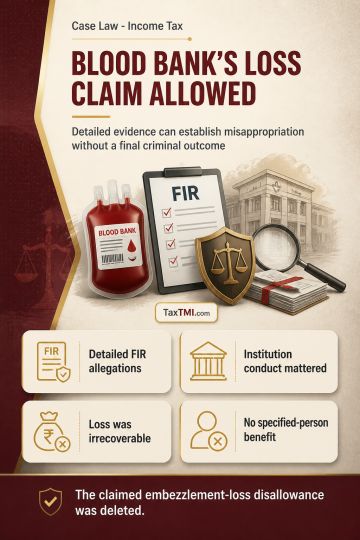
Embezzlement losses in charitable institutions remain allowable when misappropriation is established, irrecoverable, and not a specified-person benefi...
National long-distance undertaking status supports deduction where separately licensed infrastructure, resources, revenue, and expenditure establish c...
Agency reimbursement income follows contractual deposit-liability computation, while pending deposit collections do not constitute deemed-dividend loa...
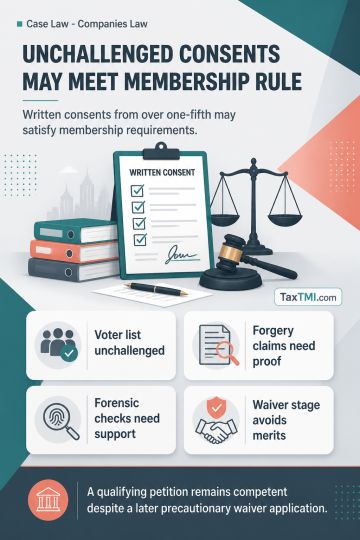
Membership-consent thresholds for oppression petitions are satisfied by unchallenged voter-list consents, while unsupported forgery claims require pro...
Classification of imported goods, specifically di-methyl lauryl amine (DMLA), under the Customs Tariff Act, 1975. The key points are: The classification of DMLA as a 'surface active agent' under heading 3402 was disputed. The test reports submitted were questioned for their validity and bona fides. The adjudicating authority did not consider the test reports furnished by the importer. The Supreme Court's ruling in Hindustan Ferodo Ltd v. Collector of Central Excise emphasizes that the onus of establishing the classification lies with the Revenue, and if evidence is not led, the appeal should be allowed. The benchmark in note 3 of chapter 34 of the Customs Tariff Act, 1975, must be met through valid test results. The order was set aside for fresh adjudication after considering the test results. The penalties imposed on individuals were found unsustainable and set aside. The dispute was remanded back to the original authority for fresh adjudication.
Classification of imported goods, specifically di-methyl lauryl amine (DMLA), under the Customs Tariff Act, 1975. The key points are: The classification of DMLA as a 'surface active agent' under heading 3402 was disputed. The test reports submitted were questioned for their validity and bona fides. The adjudicating authority did not consider the test reports furnished by the importer. The Supreme Court's ruling in Hindustan Ferodo Ltd v. Collector of Central Excise emphasizes that the onus of establishing the classification lies with the Revenue, and if evidence is not led, the appeal should be allowed. The benchmark in note 3 of chapter 34 of the Customs Tariff Act, 1975, must be met through valid test results. The order was set aside for fresh adjudication after considering the test results. The penalties imposed on individuals were found unsustainable and set aside. The dispute was remanded back to the original authority for fresh adjudication.
Note: It is a system-generated summary and is for quick reference only.
 TaxTMI
  TaxTMI
 of 4881