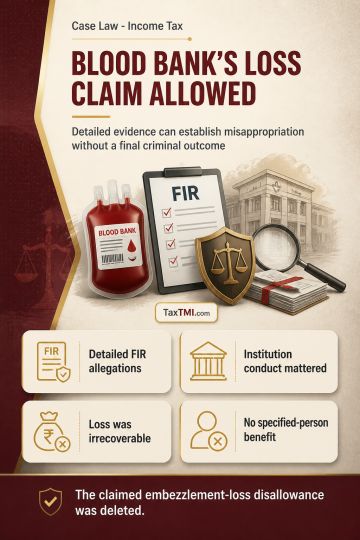
Embezzlement losses in charitable institutions remain allowable when misappropriation is established, irrecoverable, and not a specified-person benefi...
National long-distance undertaking status supports deduction where separately licensed infrastructure, resources, revenue, and expenditure establish c...
Agency reimbursement income follows contractual deposit-liability computation, while pending deposit collections do not constitute deemed-dividend loa...
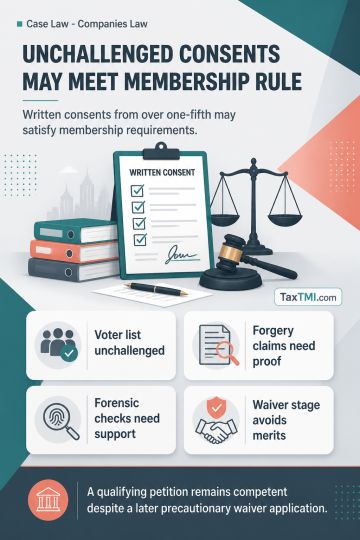
Membership-consent thresholds for oppression petitions are satisfied by unchallenged voter-list consents, while unsupported forgery claims require pro...
The judgment addresses the applicability of Section 31 of the Insolvency and Bankruptcy Code (IBC) concerning the recovery of tax dues from the successful resolution applicant who acquired the assets of the corporate debtor. The court held that once the petitioner acquired the assets through the auction process under IBC, any claims not raised earlier stand extinguished. The respondent cannot recover dues pertaining to the period prior to the petitioner's acquisition. Section 31 mandates that the approved resolution plan binds all stakeholders, including government authorities. The retrospective applicability of the 2019 amendment to Section 31, upheld by the Supreme Court, reinforces this position. The IBC aims to revive the corporate debtor, and the approved resolution plan must provide for payment of insolvency costs. Consequently, the demand notice issued by the respondent seeking pre-acquisition dues is arbitrary, violating Article 14, and the petitioner is not liable for outstanding tax dues prior to asset acquisition under IBC.
The judgment addresses the applicability of Section 31 of the Insolvency and Bankruptcy Code (IBC) concerning the recovery of tax dues from the successful resolution applicant who acquired the assets of the corporate debtor. The court held that once the petitioner acquired the assets through the auction process under IBC, any claims not raised earlier stand extinguished. The respondent cannot recover dues pertaining to the period prior to the petitioner's acquisition. Section 31 mandates that the approved resolution plan binds all stakeholders, including government authorities. The retrospective applicability of the 2019 amendment to Section 31, upheld by the Supreme Court, reinforces this position. The IBC aims to revive the corporate debtor, and the approved resolution plan must provide for payment of insolvency costs. Consequently, the demand notice issued by the respondent seeking pre-acquisition dues is arbitrary, violating Article 14, and the petitioner is not liable for outstanding tax dues prior to asset acquisition under IBC.
Note: It is a system-generated summary and is for quick reference only.
 TaxTMI
  TaxTMI
 of 4886