Loading...

⚠ ✕
❮ Top
☎ Help
☰
×

By creating an account you can:

Logo TaxTMI
Call Us / Help / Feedback✕

Contact Us At :

✉ E-mail: [email protected]

✆ Call / WhatsApp at: +91 99117 96707

For more information, Check Contact Us

FAQs :

To know Frequently Asked Questions, Check FAQs

Most Asked Video Tutorials :

For more tutorials, Check Video Tutorials

Submit Feedback/Suggestion :

Email :
Please provide your email address so we can follow up on your feedback.
Category :
Description :
Min 15 characters 0/2000
Make Most of Text Search ✕
  1. Checkout this video tutorial: How to search effectively on TaxTMI.
  2. Put words in double quotes for exact word search, eg: "income tax"
  3. Avoid noise words such as : 'and, of, the, a'
  4. Sort by Relevance to get the most relevant document.
  5. Press Enter to add multiple terms/multiple phrases, and then click on Search to Search.
  6. Text Search
  7. The system will try to fetch results that contains ALL your words.
  8. Once you add keywords, you'll see a new 'Search In' filter that makes your results even more precise.
  9. Text Search
╳
Add to...
You have not created any category. Kindly create one to bookmark this item!
✕
Create New Category
Hide
Title :
Description :
❮❮ Hide
❮ Default View
Expand ❯❯
Close ✕
🔎 Filters / Advanced Search ❯
TEXT

Press 'Enter' to add multiple search terms. Rules for Better Search

Search In
Main Text + AI Text ❯
  • Main Text
  • Main Text + AI Text
  • AI Text
Law:
---- All Laws---- ❯
  • ---- All Laws----
  • Income Tax
  • Direct Taxes
  • Benami Property
  • Central GST Laws
  • SGST - State GST Laws
  • Customs
  • FTP - Foreign Trade Policy
  • SEZ - Special Economic Zone
  • FEMA - Foreign Exchange Management
  • Companies Law
  • SEBI - Securities & Exchange Board of India
  • IBC - Insolvency and Bankruptcy
  • Law of Competition
  • PMLA - Money-Laundering
  • Indian Laws
  • Bill / Finance Bills
  • Wealth Tax
  • Service Tax
  • Central Excise
  • VAT / Sales Tax
Month:
---- All Months ---- ❯
  • ---- All Months ----
  • January
  • February
  • March
  • April
  • May
  • June
  • July
  • August
  • September
  • October
  • November
  • December
Year:
---- All Years ---- ❯
  • ---- All Years ----
  • 2026
  • 2025
  • 2024
  • 2023
  • 2022
  • 2021
  • 2020
  • 2019
  • 2018
  • 2017
  • 2016
  • 2015
  • 2014
  • 2013
  • 2012
  • 2011
Sort By: ?
In Sort By 'Default', exact matches for text search are shown at the top, followed by the remaining results in their regular order.
Relevance Default Date
☰   Show Results ❯
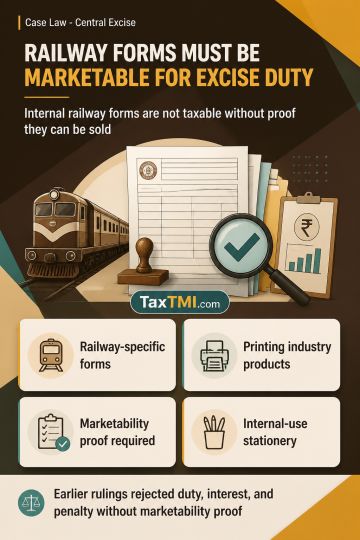
    Marketability of railway-only printed forms determines excise liability, with internal-use stationery treated as printing-industry products.
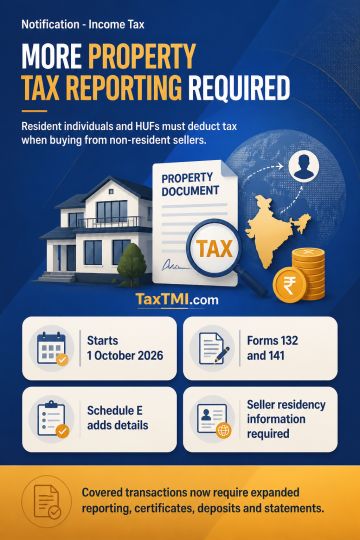
    TDS reporting for property transfers now covers resident individual and HUF buyers acquiring property from non-resident sellers.
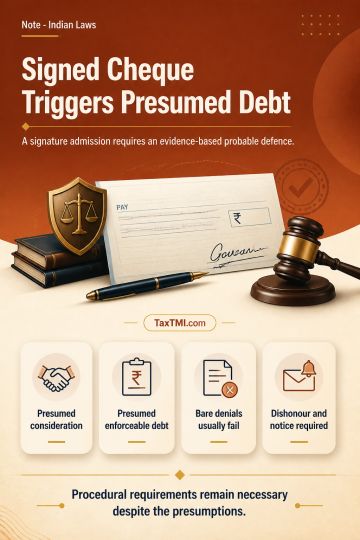
    Admitted cheque signature in dishonour prosecutions activates presumptions of consideration and debt, requiring an evidence-based probable defence.
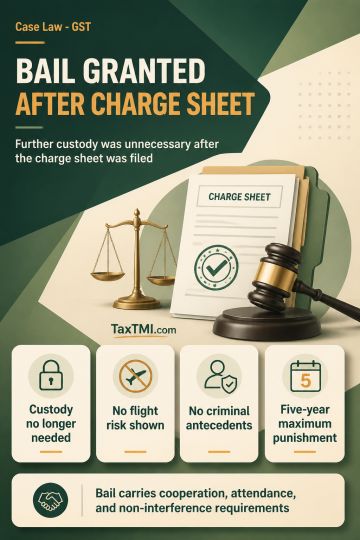
    Regular bail after charge-sheet filing granted where custody was no longer required in alleged GST input-tax-credit fraud.
    Duty-free shop sales remain subject to domestic regulatory laws, while nicotine pouch licensing requires product-specific classification assessment.
    Prospective GST liability limits tax on taxi-stand land rentals, while allotment claims require a reasoned determination.
    E-way bill delivery-address compliance supports Section 129 penalties even where tax is paid and the address is later registered.
    Contractual GST allocation: Writ remedy upheld where acceptance terms required GST payment beyond quoted rates.
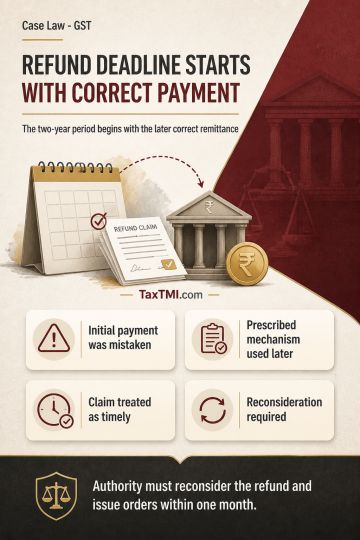
    Kerala Flood Cess refund limitation runs from correct remittance, treating claims filed within the statutory period as timely.
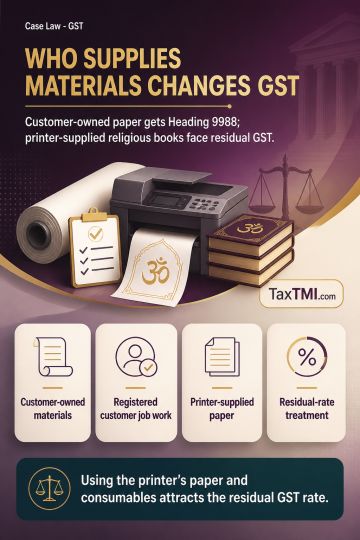
    Printing on customer-owned inputs qualifies under Heading 9988, while printer-supplied religious book printing attracts residual-rate GST.
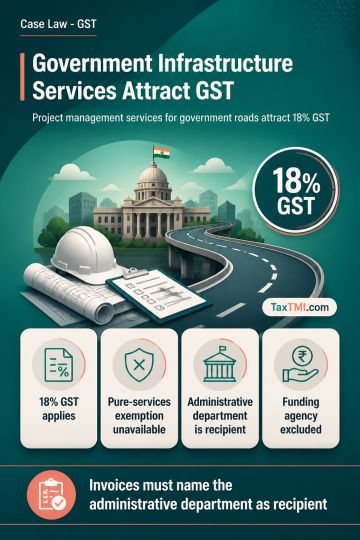
    Project management services for government infrastructure remain taxable, and invoices must identify the administrative department as recipient.
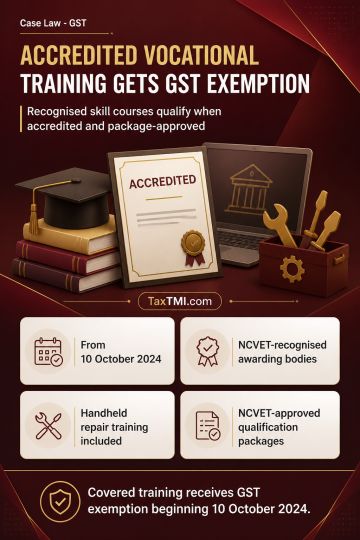
    NSQF-aligned vocational training qualifies for GST exemption when supplied by appropriately accredited bodies under approved qualification packages.
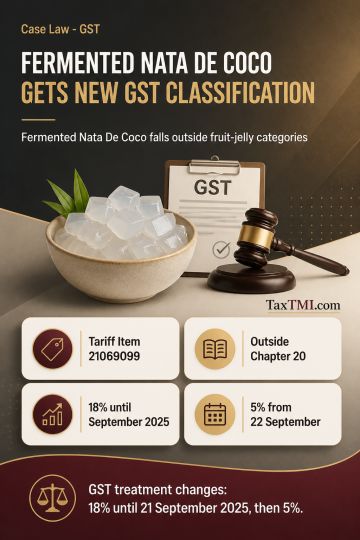
    Residual food-preparation classification places fermented Nata De Coco outside fruit-jelly categories, changing its GST treatment across notified peri...
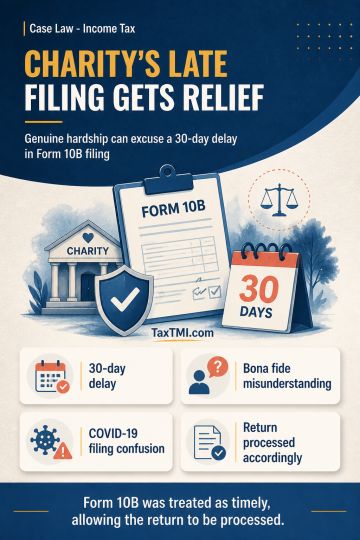
    Genuine hardship permits condonation of delayed Form 10B where bona fide compliance misunderstanding would otherwise defeat charitable exemption.
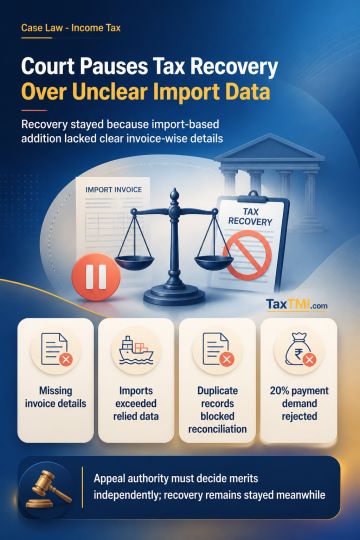
    Natural justice breaches in import-data additions justified staying recovery while appeal remained pending despite deposit guidance.
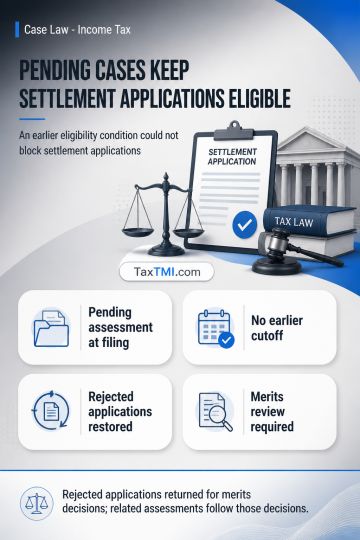
    Settlement application eligibility requires a pending assessment when filed, preventing an extra prior-eligibility condition from blocking considerati...
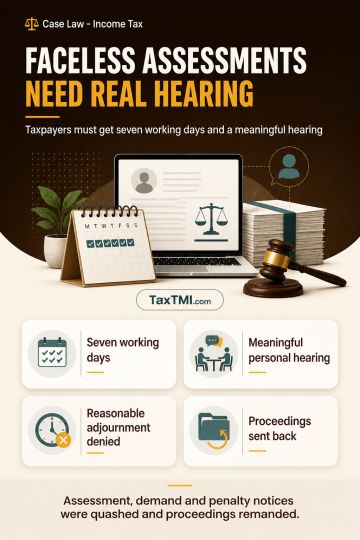
    Adequate Hearing in Faceless Assessments Requires the prescribed response period and meaningful personal-hearing opportunity before assessment.
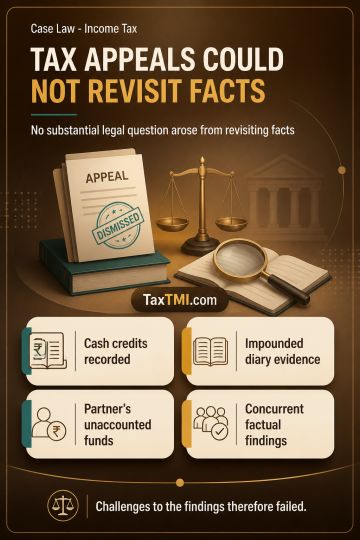
    Substantial questions of law do not arise where income-tax appeals merely seek reassessment of concurrent factual findings.
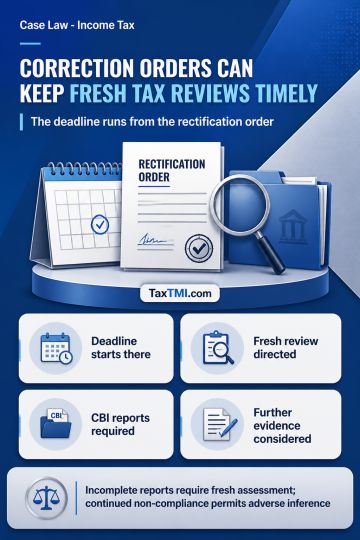
    Limitation for reassessments runs from the rectification order when it directs de novo assessment, preserving timely reassessment proceedings.
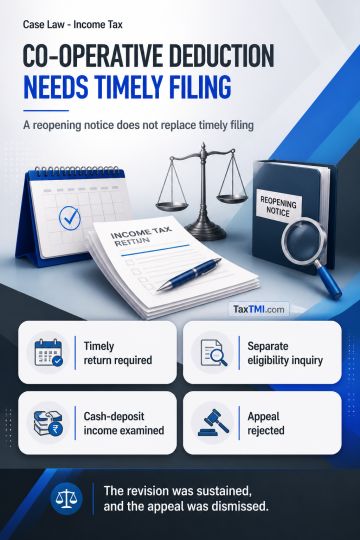
    Timely return requirement for co-operative deduction supports revision where reassessment ignored eligibility linked to cash-deposit income.
❮
❯
❯❯
Maximize Maximize Maximize
0 / 200
Expand Note
Add to Folder

No Folders have been created

+

Are you sure you want to delete "My most important" ?

NOTE:

Highlights
Showing Results for :
Reset Filters
Results Found:
Show All Summaries Hide All Summaries

Highlights

Back

All Highlights

Showing Results for :
Reset Filters
No Records Found

Highlights

Back

All Highlights

The NCLAT considered the applicability of time limitation for...

Appeal Time Limit Starts with Order Pronouncement; NCLAT Condones Delay Based on Flexible "Sufficient Cause" Standard.

Contents
Summary
Note

Note

-

Bookmark

Print

Print

IBC October 17, 2024 Case Laws AT
The NCLAT considered the applicability of time limitation for filing an appeal and whether there was sufficient cause for condonation of delay. It held that when an order is not pronounced in open court, the limitation period for filing an appeal does not commence, as per the Supreme Court's judgment in Sanjay Pandurang Kalate. Although the appellant claimed the order was not uploaded until 20.02.2024, the liquidator had communicated the order to the appellant on 25.01.2024. Therefore, the appellant could not claim that the limitation period would not begin at least from 25.01.2024. The expression "sufficient cause" is elastic, allowing courts to apply the law meaningfully to serve the ends of justice. The Supreme Court in Sheo Raj Singh vs. Union of India held that condonation of delay is a discretionary power, and its exercise depends on the sufficiency of the cause shown and the acceptability of the explanation, regardless of the length of delay. In the present case, no date of uploading was brought on record, so the limitation period could not be pegged to the date of uploading. However, since the appeal was filed on 02.03.2024, within 45 days from 25.01.2024 when the order was communicated, the NCLAT found sufficient cause to condone the delay.

Topics

Acts Income Tax