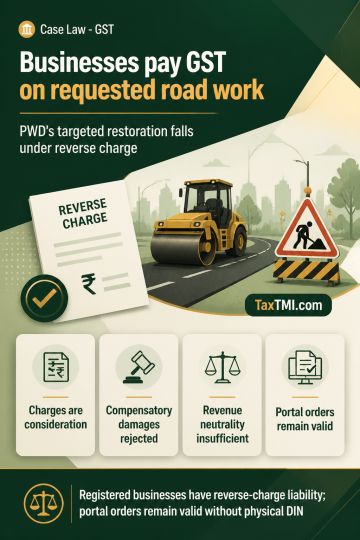
Request-driven road restoration attracts reverse-charge GST, not governmental-function treatment or compensatory-damages status for business recipient...
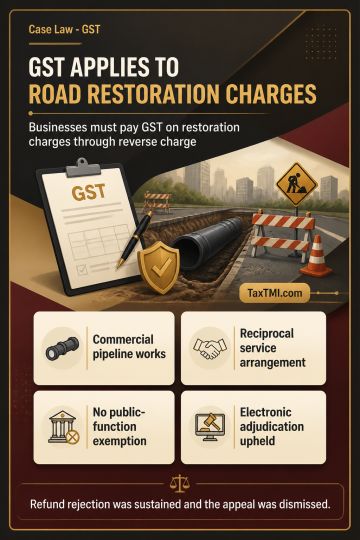
Road restoration charges for commercial pipeline works are taxable Government services, with reverse charge liability and no public-function exemption...
Model-wise import cap monitoring cannot justify withholding used multifunction machines where all-India tracking is absent and full security is furnis...
The summary focuses on the interpretation and applicability of Section 271D and Section 269SS of the Income Tax Act. The key points are: Section 271D imposes a penalty for violating the provisions of Section 269SS, which prohibits receiving a sum exceeding Rs. 20,000 as a loan or deposit from any person. However, Section 269SS does not cover the receipt of cash consideration for the sale of immovable property. The authorities erroneously interpreted Section 269SS and imposed a penalty u/s 271D for receiving cash consideration from the sale of immovable properties. The Appellate Tribunal held that the Assessing Officer committed an error in invoking Sections 269SS and 271D in this case and quashed the penalty imposed.
The summary focuses on the interpretation and applicability of Section 271D and Section 269SS of the Income Tax Act. The key points are: Section 271D imposes a penalty for violating the provisions of Section 269SS, which prohibits receiving a sum exceeding Rs. 20,000 as a loan or deposit from any person. However, Section 269SS does not cover the receipt of cash consideration for the sale of immovable property. The authorities erroneously interpreted Section 269SS and imposed a penalty u/s 271D for receiving cash consideration from the sale of immovable properties. The Appellate Tribunal held that the Assessing Officer committed an error in invoking Sections 269SS and 271D in this case and quashed the penalty imposed.
Note: It is a system-generated summary and is for quick reference only.
 TaxTMI
  TaxTMI
 of 4918