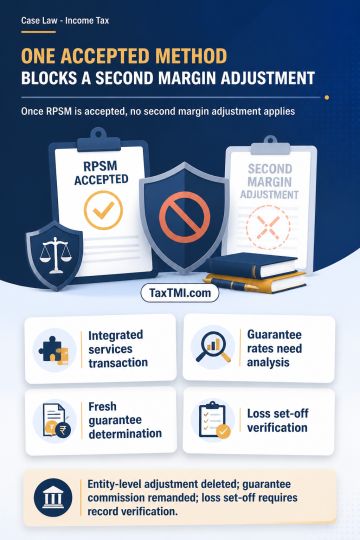
Form 26AS evidence requires successor-entity accounting verification after business transfer, while invoice-supported related-party advertising expend...
Money-laundering judgment timing requires awaiting the scheduled-offence decision despite continuation of the underlying trial where outcomes directly...
Accredited investor eligibility expands through securities-market exposure, while alternative investment fund disputes require prescribed resolution a...
Page of 4916
Press 'Enter' after typing page number.
41 to 60 of 98302 Results
❮
❯
❯❯
0 / 200
Expand Note
Add to Folder
No Folders have been created
+
Are you sure you want to delete "My most important" ?
Imported raw sesame seeds duty-free under Advance Authorization Scheme were allegedly diverted and sold in the local market instead of being used for export production as specified. The appellant claimed to have exported the processed sesame seeds by procuring indigenous duty-paid goods and claiming the stipulated 1% SION norm process loss. Customs discharged the bond after due consideration. For the alleged diversion against 4 contract notes, 3 were canceled, and for the 4th, hulled sesame seeds were supplied, disproving diversion. Documents relied upon by the department failed to evidence diversion. The appellant sought clarification on using indigenous raw material and revision of norms, which was duly considered. Evidence indicates procurement of indigenous material rather than diversion, appreciated by DGFT's practical and pragmatic stance of revising the lower 1% norm. DGFT's Policy Interpretation Committee permitted sourcing domestic material for deficiency. DGFT issued EODCs, and Customs discharged the bond accordingly. The adjudicating authority correctly granted relief after considering arguments and developments. The CESTAT upheld the order, dismissing the department's appeals as devoid of merit and the appellant's appeal seeking drawback adjustment as infructuous.
Imported raw sesame seeds duty-free under Advance Authorization Scheme were allegedly diverted and sold in the local market instead of being used for export production as specified. The appellant claimed to have exported the processed sesame seeds by procuring indigenous duty-paid goods and claiming the stipulated 1% SION norm process loss. Customs discharged the bond after due consideration. For the alleged diversion against 4 contract notes, 3 were canceled, and for the 4th, hulled sesame seeds were supplied, disproving diversion. Documents relied upon by the department failed to evidence diversion. The appellant sought clarification on using indigenous raw material and revision of norms, which was duly considered. Evidence indicates procurement of indigenous material rather than diversion, appreciated by DGFT's practical and pragmatic stance of revising the lower 1% norm. DGFT's Policy Interpretation Committee permitted sourcing domestic material for deficiency. DGFT issued EODCs, and Customs discharged the bond accordingly. The adjudicating authority correctly granted relief after considering arguments and developments. The CESTAT upheld the order, dismissing the department's appeals as devoid of merit and the appellant's appeal seeking drawback adjustment as infructuous.
Note: It is a system-generated summary and is for quick reference only.
 TaxTMI
 TaxTMI

 of 4916