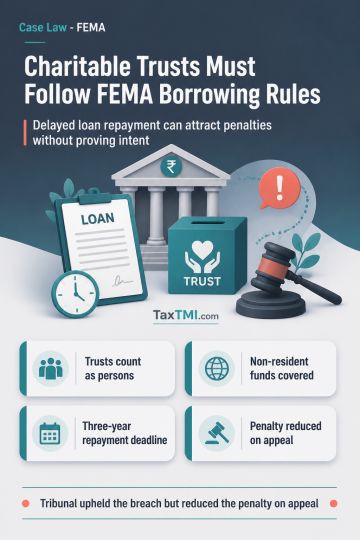
FEMA borrowing restrictions bind charitable trusts, and civil penalties apply without proving intent for delayed repayment of non-resident rupee loans...
The CESTAT held that in the absence of Section 3A of the Central Excise Act, 1944, and Rules 96ZO, ZP, and ZQ of the Central Excise Rules, 1944, along with any saving clause, the adjudicating authority lacked statutory power to decide matters related to the compounded levy scheme after March 1, 2001. Consequently, the orders-in-original passed by the adjudicating authority, holding the appellants liable to pay duty under the compounded levy scheme, were non-est and lacked legal authority. The entire proceedings, including the show cause notices and adjudication thereof, were vitiated. Without a valid provision or saving clause, the adjudication proceedings were illegal and incorrect, and no demand could be confirmed. Therefore, the impugned orders were unsustainable, and the appeal was allowed.
The CESTAT held that in the absence of Section 3A of the Central Excise Act, 1944, and Rules 96ZO, ZP, and ZQ of the Central Excise Rules, 1944, along with any saving clause, the adjudicating authority lacked statutory power to decide matters related to the compounded levy scheme after March 1, 2001. Consequently, the orders-in-original passed by the adjudicating authority, holding the appellants liable to pay duty under the compounded levy scheme, were non-est and lacked legal authority. The entire proceedings, including the show cause notices and adjudication thereof, were vitiated. Without a valid provision or saving clause, the adjudication proceedings were illegal and incorrect, and no demand could be confirmed. Therefore, the impugned orders were unsustainable, and the appeal was allowed.
Note: It is a system-generated summary and is for quick reference only.
 TaxTMI
  TaxTMI
 of 4888