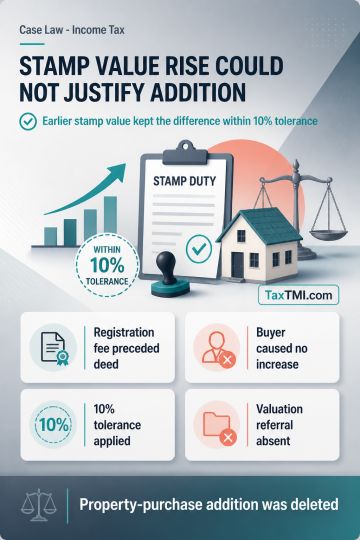
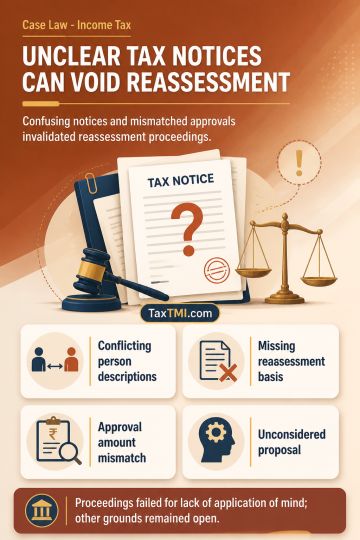
Stamp valuation increases after registration-fee payment led to deletion of property-purchase addition within tolerance and without valuation referral...
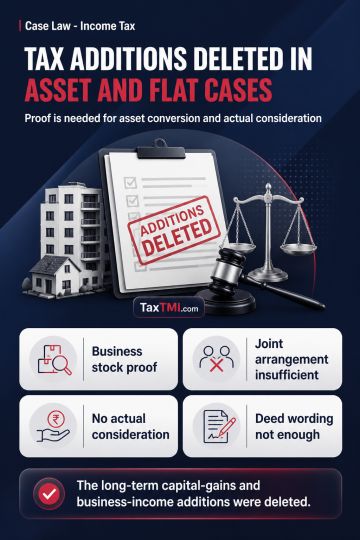
Capital Asset Conversion Requires Proven Business Stock Treatment; Paper Consideration in Spousal Flat Transfers Does Not Create Taxable Business Inco...
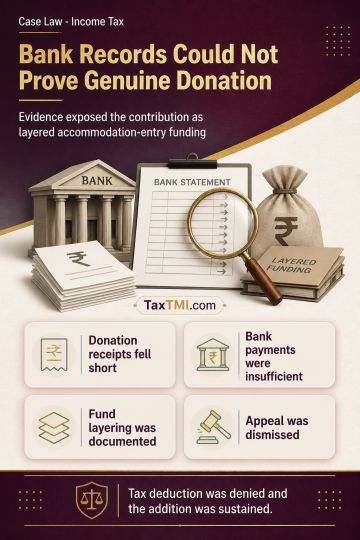
Human-probability test defeats political donation deduction where banking records mask accommodation-entry fund layering and evidence shows non-genuin...
Page of 4886
Press 'Enter' after typing page number.
441 to 460 of 97714 Results
❮
❯
❯❯
0 / 200
Expand Note
Add to Folder
No Folders have been created
+
Are you sure you want to delete "My most important" ?
The High Court held that the Income Tax authorities have the power to seek interim custody of currency notes seized and produced before the jurisdictional magistrate or reported to the magistrate u/s 102 of the Criminal Procedure Code. When the Income Tax Act empowers the competent authority to requisition assets of assessees and adjust them towards liabilities, if there is reason to believe that the asset represents undisclosed income or property, the competent authority is best suited to hold the seized currency notes until the inquiry or trial concludes. Section 132A allows requisitioning books of account, and the competent authority can seek interim custody of seized assets, even if unable to issue a requisition u/s 132A when the asset is produced before the magistrate. The competent authority can apply for interim custody u/s 451 of the CrPC to prevent Sections 132A and 132B from becoming futile. The direction in an earlier case for returning the amount if proceedings are not completed within six months is unwarranted, as disbursement can be ordered only at the conclusion of the inquiry or trial u/s 452 of the CrPC.
The High Court held that the Income Tax authorities have the power to seek interim custody of currency notes seized and produced before the jurisdictional magistrate or reported to the magistrate u/s 102 of the Criminal Procedure Code. When the Income Tax Act empowers the competent authority to requisition assets of assessees and adjust them towards liabilities, if there is reason to believe that the asset represents undisclosed income or property, the competent authority is best suited to hold the seized currency notes until the inquiry or trial concludes. Section 132A allows requisitioning books of account, and the competent authority can seek interim custody of seized assets, even if unable to issue a requisition u/s 132A when the asset is produced before the magistrate. The competent authority can apply for interim custody u/s 451 of the CrPC to prevent Sections 132A and 132B from becoming futile. The direction in an earlier case for returning the amount if proceedings are not completed within six months is unwarranted, as disbursement can be ordered only at the conclusion of the inquiry or trial u/s 452 of the CrPC.
Note: It is a system-generated summary and is for quick reference only.
 TaxTMI
  TaxTMI
 of 4886