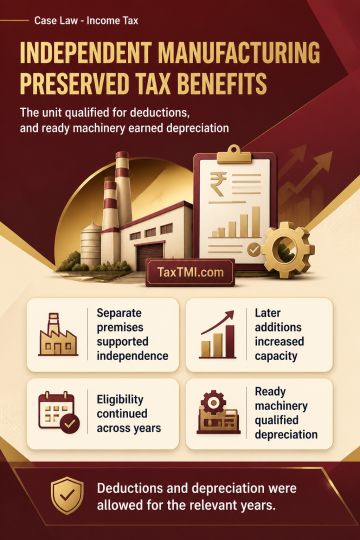
Independent manufacturing undertaking eligibility preserves Section 80IA/80IB deductions, while machinery kept ready for use qualifies for depreciatio...
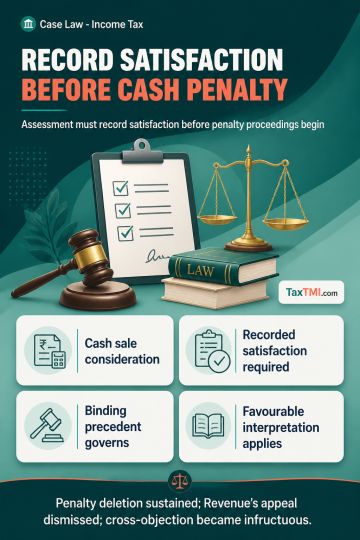
Assessing Officer Satisfaction Requirement Bars Penalty for Cash Receipt in Immovable-Property Sale Cases Where Initiation Lacks Recorded Satisfaction...
Self-assessed import entries remain appealable, while bona fide classification disputes without misdeclaration cannot justify confiscation or penaltie...
Page of 4894
Press 'Enter' after typing page number.
641 to 660 of 97867 Results
❮
❯
❯❯
0 / 200
Expand Note
Add to Folder
No Folders have been created
+
Are you sure you want to delete "My most important" ?
The High Court's judgment addressed the interpretation of Section 43A regarding losses arising from exchange rate fluctuations on foreign currency loans utilized for acquiring assets both within and outside India. The court held that Section 43A mandates capitalizing such losses for assets imported from abroad. However, for assets acquired locally, the applicability of Section 37(1) must be examined to determine if the expenditure qualifies as revenue or capital. The court remanded the matter to the ITAT to determine whether the expenditure disallowed by the AO and CIT-A, but allowed by the ITAT, qualifies as non-capital expenditure u/s 37(1), considering the substance of the expenditure. The Supreme Court's judgment in Wipro Finance Ltd. clarified that Section 43A's positive obligation does not necessarily mean the converse - that exchange rate losses on loans for locally acquired assets must be treated as capital expenditure. The High Court emphasized expediting the proceedings, given the vintage of the case.
The High Court's judgment addressed the interpretation of Section 43A regarding losses arising from exchange rate fluctuations on foreign currency loans utilized for acquiring assets both within and outside India. The court held that Section 43A mandates capitalizing such losses for assets imported from abroad. However, for assets acquired locally, the applicability of Section 37(1) must be examined to determine if the expenditure qualifies as revenue or capital. The court remanded the matter to the ITAT to determine whether the expenditure disallowed by the AO and CIT-A, but allowed by the ITAT, qualifies as non-capital expenditure u/s 37(1), considering the substance of the expenditure. The Supreme Court's judgment in Wipro Finance Ltd. clarified that Section 43A's positive obligation does not necessarily mean the converse - that exchange rate losses on loans for locally acquired assets must be treated as capital expenditure. The High Court emphasized expediting the proceedings, given the vintage of the case.
Note: It is a system-generated summary and is for quick reference only.
 TaxTMI
  TaxTMI
 of 4894