Capital-gains exemption for charitable trusts extends to qualifying fixed deposits, while unrecoverable TDS write-offs may constitute income applicati...
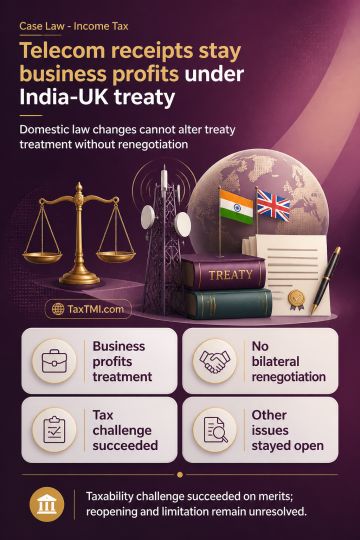
India-UK treaty characterisation of telecom-service receipts as business profits withstands unilateral domestic-law amendments for Indian tax purposes...
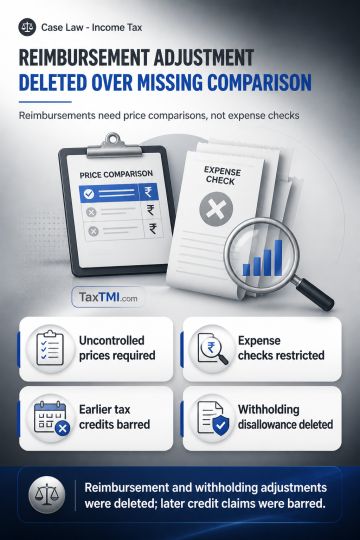
Transfer-pricing reimbursement adjustments require uncontrolled comparables and cannot become expense-genuineness reviews, resulting in deletion of th...
Food import sampling requirements support provisional release where unseized consignments conform to standards and raw areca classification is unestab...
Page of 4891
Press 'Enter' after typing page number.
481 to 500 of 97809 Results
❮
❯
❯❯
0 / 200
Expand Note
Add to Folder
No Folders have been created
+
Are you sure you want to delete "My most important" ?
The High Court's judgment addressed the interpretation of Section 43A regarding losses arising from exchange rate fluctuations on foreign currency loans utilized for acquiring assets both within and outside India. The court held that Section 43A mandates capitalizing such losses for assets imported from abroad. However, for assets acquired locally, the applicability of Section 37(1) must be examined to determine if the expenditure qualifies as revenue or capital. The court remanded the matter to the ITAT to determine whether the expenditure disallowed by the AO and CIT-A, but allowed by the ITAT, qualifies as non-capital expenditure u/s 37(1), considering the substance of the expenditure. The Supreme Court's judgment in Wipro Finance Ltd. clarified that Section 43A's positive obligation does not necessarily mean the converse - that exchange rate losses on loans for locally acquired assets must be treated as capital expenditure. The High Court emphasized expediting the proceedings, given the vintage of the case.
The High Court's judgment addressed the interpretation of Section 43A regarding losses arising from exchange rate fluctuations on foreign currency loans utilized for acquiring assets both within and outside India. The court held that Section 43A mandates capitalizing such losses for assets imported from abroad. However, for assets acquired locally, the applicability of Section 37(1) must be examined to determine if the expenditure qualifies as revenue or capital. The court remanded the matter to the ITAT to determine whether the expenditure disallowed by the AO and CIT-A, but allowed by the ITAT, qualifies as non-capital expenditure u/s 37(1), considering the substance of the expenditure. The Supreme Court's judgment in Wipro Finance Ltd. clarified that Section 43A's positive obligation does not necessarily mean the converse - that exchange rate losses on loans for locally acquired assets must be treated as capital expenditure. The High Court emphasized expediting the proceedings, given the vintage of the case.
Note: It is a system-generated summary and is for quick reference only.
 TaxTMI
  TaxTMI
 of 4891