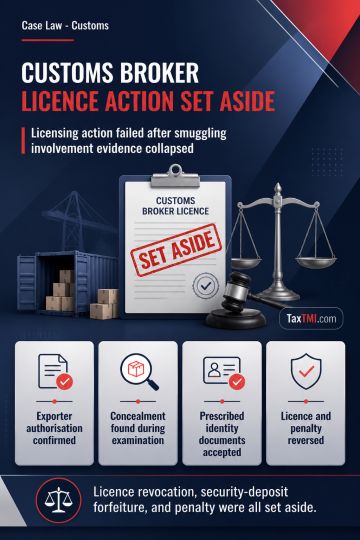
Customs Broker licensing proceedings fail when their offence-report foundation collapses and authorisation, advisory, and KYC duties remain unbreached...
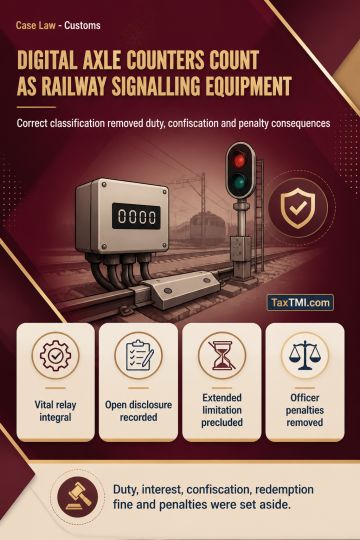
Tariff classification of Digital Axle Counters affirmed as electro-mechanical railway signalling equipment, eliminating duty, confiscation and penalty...
The NCLAT upheld the NCLT's decision to refuse waiver u/ss 244(1)(a) and (b) of the Companies Act 2013 to the Appellants, who held only 5.83% shareholding, to file an oppression and mismanagement case u/s 241. While the NCLAT can make a preliminary assessment to determine if the petition falls within Sections 241 and 244, it found no exceptional circumstances to bypass the minimum shareholding requirement. The Appellants' primary grievance revolved around the removal of one Appellant as Director, which the Supreme Court has held cannot trigger oppression relief u/ss 241 and 242. The petition did not substantiate a genuine case of oppression and mismanagement, and the NCLT rightly refused the waiver based on its assessment.
The NCLAT upheld the NCLT's decision to refuse waiver u/ss 244(1)(a) and (b) of the Companies Act 2013 to the Appellants, who held only 5.83% shareholding, to file an oppression and mismanagement case u/s 241. While the NCLAT can make a preliminary assessment to determine if the petition falls within Sections 241 and 244, it found no exceptional circumstances to bypass the minimum shareholding requirement. The Appellants' primary grievance revolved around the removal of one Appellant as Director, which the Supreme Court has held cannot trigger oppression relief u/ss 241 and 242. The petition did not substantiate a genuine case of oppression and mismanagement, and the NCLT rightly refused the waiver based on its assessment.
Note: It is a system-generated summary and is for quick reference only.
 TaxTMI
  TaxTMI
 of 4883