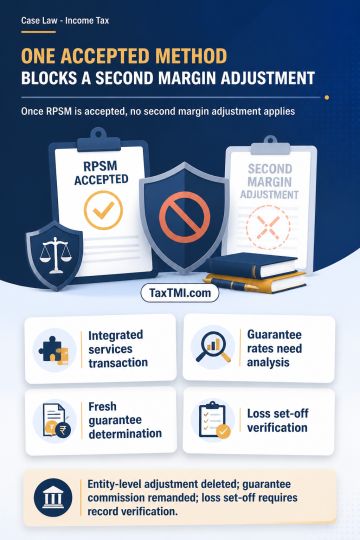
Form 26AS evidence requires successor-entity accounting verification after business transfer, while invoice-supported related-party advertising expend...
Money-laundering judgment timing requires awaiting the scheduled-offence decision despite continuation of the underlying trial where outcomes directly...
Accredited investor eligibility expands through securities-market exposure, while alternative investment fund disputes require prescribed resolution a...
Page of 4916
Press 'Enter' after typing page number.
41 to 60 of 98302 Results
❮
❯
❯❯
0 / 200
Expand Note
Add to Folder
No Folders have been created
+
Are you sure you want to delete "My most important" ?
Penalty u/s 270A was imposed by disallowing 30% of indexed cost of development expenses concerning Long Term Capital Gain offered by the assessee due to failure to furnish certain supporting evidence. The assessee had submitted all details before the Assessing Officer and explained the reason for not furnishing a few vouchers as they were misplaced but was willing to produce them. The Assessing Officer proceeded to levy penalty u/s 270A on an estimated basis. The Appellate Tribunal noted that the Assessing Officer's action of levying penalty cannot be countenanced. Considering the assessee's bonafide explanation and disclosure of material facts, and as the disallowance was purely on estimation, the Tribunal held it is not a fit case for penalty u/s 270A for underreporting of income. The penalty imposed by the Assessing Officer and upheld by the Commissioner of Income Tax (Appeals) was directed to be deleted, allowing the assessee's appeal.
Penalty u/s 270A was imposed by disallowing 30% of indexed cost of development expenses concerning Long Term Capital Gain offered by the assessee due to failure to furnish certain supporting evidence. The assessee had submitted all details before the Assessing Officer and explained the reason for not furnishing a few vouchers as they were misplaced but was willing to produce them. The Assessing Officer proceeded to levy penalty u/s 270A on an estimated basis. The Appellate Tribunal noted that the Assessing Officer's action of levying penalty cannot be countenanced. Considering the assessee's bonafide explanation and disclosure of material facts, and as the disallowance was purely on estimation, the Tribunal held it is not a fit case for penalty u/s 270A for underreporting of income. The penalty imposed by the Assessing Officer and upheld by the Commissioner of Income Tax (Appeals) was directed to be deleted, allowing the assessee's appeal.
Note: It is a system-generated summary and is for quick reference only.
 TaxTMI
 TaxTMI

 of 4916