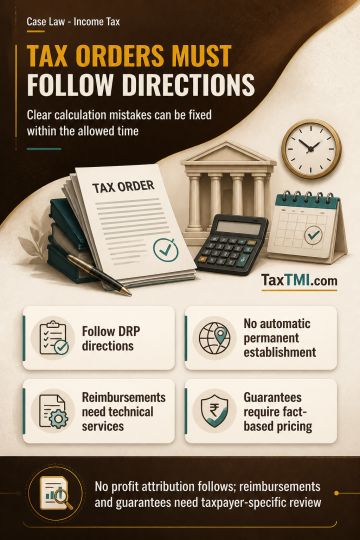
Supervisory permanent establishment requires project-wise duration and qualifying construction nexus; offshore supplies and salary reimbursements rema...
The case pertains to the reopening of assessment u/s 147, where the reasons recorded were based on audit objections raised by the internal audit party regarding underassessment of income and default determination of Transfer Pricing (TP) Adjustment. The Transfer Pricing Officer (TPO) made a markup of 12% on direct costs, but the audit objection suggested reducing it to 9.17% after accounting for foreign exchange risk of 1%. The court held that the TPO's order was detailed, considering all aspects, and the audit objection amounted to a mere change of opinion without any failure on the part of the petitioner to disclose material facts. Since the impugned notice was issued beyond four years, the respondent could not have assumed jurisdiction based on audit objections. Regarding the reduced exchange gain on sale of shares, the assessee made full disclosure, and there was no failure to disclose material facts, preventing the respondent from reopening the assessment u/s 147's proviso. The decision was in favor of the assessee.
The case pertains to the reopening of assessment u/s 147, where the reasons recorded were based on audit objections raised by the internal audit party regarding underassessment of income and default determination of Transfer Pricing (TP) Adjustment. The Transfer Pricing Officer (TPO) made a markup of 12% on direct costs, but the audit objection suggested reducing it to 9.17% after accounting for foreign exchange risk of 1%. The court held that the TPO's order was detailed, considering all aspects, and the audit objection amounted to a mere change of opinion without any failure on the part of the petitioner to disclose material facts. Since the impugned notice was issued beyond four years, the respondent could not have assumed jurisdiction based on audit objections. Regarding the reduced exchange gain on sale of shares, the assessee made full disclosure, and there was no failure to disclose material facts, preventing the respondent from reopening the assessment u/s 147's proviso. The decision was in favor of the assessee.
Note: It is a system-generated summary and is for quick reference only.
 TaxTMI
  TaxTMI
 of 4881