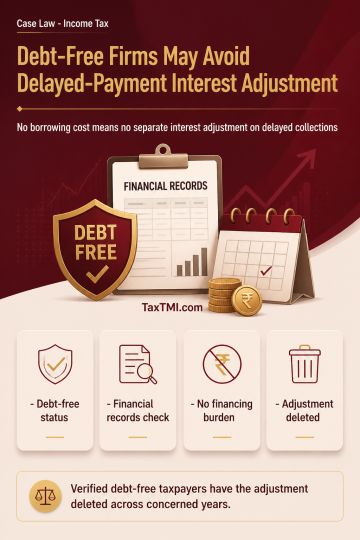
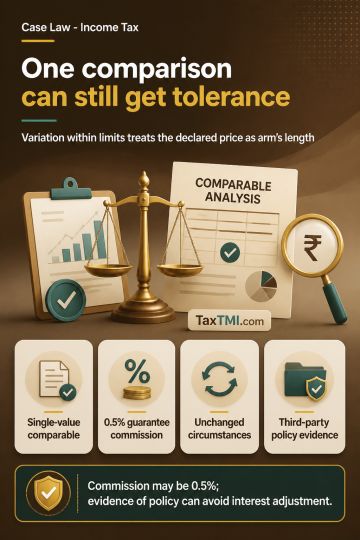
Transfer-pricing aggregation of distinct support-service and subcontract transactions was rejected, while debt-free receivables attracted no notional ...
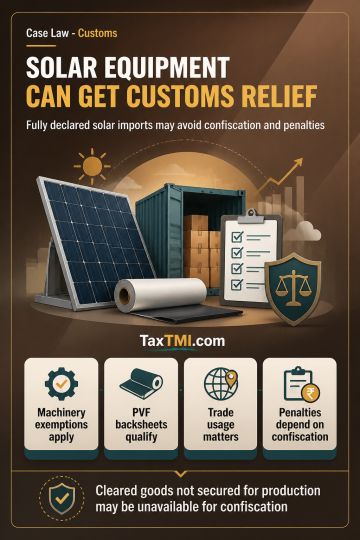
Customs exemptions cover photovoltaic assembly machinery and PVF backsheets, while fully declared cleared imports may avoid confiscation and penalties...
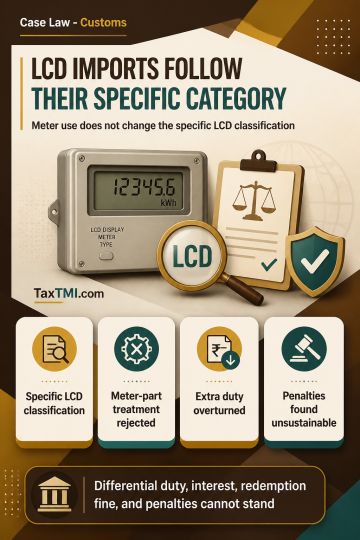
Specific tariff classification for LCD devices overrides treatment as electricity-meter parts, defeating differential duty, extended limitation, and p...
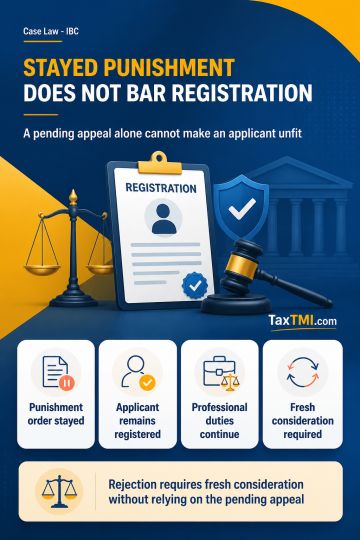
Stayed disciplinary punishment does not establish unfitness for insolvency professional registration; reconsideration must disregard mere pendency of ...
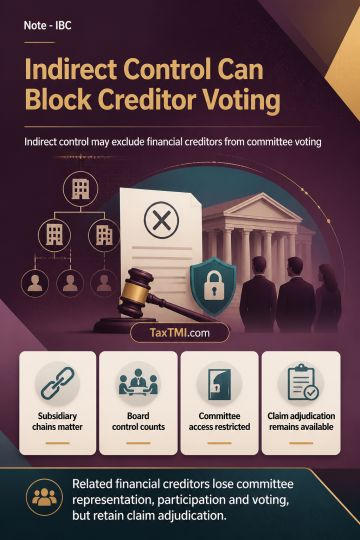
Indirect corporate control can create related-party status, excluding financial creditors from Committee of Creditors representation, participation an...
Page of 4881
Press 'Enter' after typing page number.
101 to 120 of 97618 Results
❮
❯
❯❯
0 / 200
Expand Note
Add to Folder
No Folders have been created
+
Are you sure you want to delete "My most important" ?
The dispute centered around the classification of imported goods, calcium carbonate, under the appropriate Customs Tariff Heading (CTH). The revenue classified it as calcium carbonate under CTH 28365000, while the appellant declared it as calcite powder falling under CTH 25369030. The case hinged on the observation of the Chemical Examiner at the Customs Laboratory, Kandla, who opined that the imported goods were calcium carbonate. However, several factors undermined the revenue's claim. Firstly, to classify under CTH 28365000, the goods must conform to Indian Standard specifications, which was not tested. Secondly, Board Circulars 43/2017-Cus. and 15/2009-Cus. acknowledged that the Kandla laboratory lacked the facility to test the imported goods accurately. Furthermore, a CESTAT precedent held that laboratory test reports cannot be accepted when the facility lacks requisite testing capabilities. Consequently, the revenue's claim based solely on the Kandla laboratory report, which lacked proper testing facilities, was deemed untenable. The impugned orders were set aside, and the appeal was allowed.
The dispute centered around the classification of imported goods, calcium carbonate, under the appropriate Customs Tariff Heading (CTH). The revenue classified it as calcium carbonate under CTH 28365000, while the appellant declared it as calcite powder falling under CTH 25369030. The case hinged on the observation of the Chemical Examiner at the Customs Laboratory, Kandla, who opined that the imported goods were calcium carbonate. However, several factors undermined the revenue's claim. Firstly, to classify under CTH 28365000, the goods must conform to Indian Standard specifications, which was not tested. Secondly, Board Circulars 43/2017-Cus. and 15/2009-Cus. acknowledged that the Kandla laboratory lacked the facility to test the imported goods accurately. Furthermore, a CESTAT precedent held that laboratory test reports cannot be accepted when the facility lacks requisite testing capabilities. Consequently, the revenue's claim based solely on the Kandla laboratory report, which lacked proper testing facilities, was deemed untenable. The impugned orders were set aside, and the appeal was allowed.
Note: It is a system-generated summary and is for quick reference only.
 TaxTMI
  TaxTMI
 of 4881