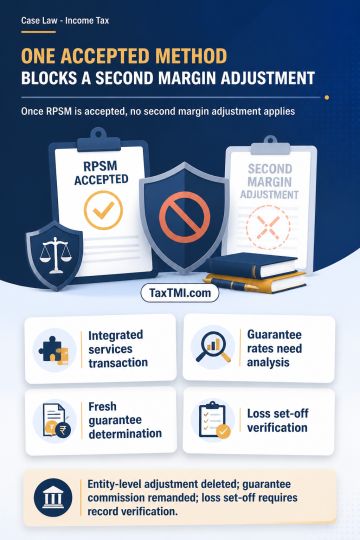
Form 26AS evidence requires successor-entity accounting verification after business transfer, while invoice-supported related-party advertising expend...
Money-laundering judgment timing requires awaiting the scheduled-offence decision despite continuation of the underlying trial where outcomes directly...
Accredited investor eligibility expands through securities-market exposure, while alternative investment fund disputes require prescribed resolution a...
Page of 4916
Press 'Enter' after typing page number.
41 to 60 of 98302 Results
❮
❯
❯❯
0 / 200
Expand Note
Add to Folder
No Folders have been created
+
Are you sure you want to delete "My most important" ?
Taxability of employee cost reimbursements as Fee for Technical Services (FTS) under the India-Japan tax treaty. The assessee, a Japanese company, seconded employees (expats) to its Indian associated enterprises (AEs). The Revenue contended that the expats rendered managerial/technical services, and the reimbursements received were taxable as FTS. However, the assessee argued that the expats worked as employees of the Indian AEs, and the payments were pure salary reimbursements. The Tribunal examined the terms of the secondment agreements and memorandums of understanding, which indicated that the expats worked under the direct control and supervision of the Indian AEs. The Tribunal held that no evidence was provided to substantiate the Revenue's claim of managerial/consultancy services rendered. The reimbursements were mere cross-charges of salary costs, taxable as salary income in the hands of the expat employees, not as FTS in the hands of the assessee. Consequently, the addition of FTS was deleted.
Taxability of employee cost reimbursements as Fee for Technical Services (FTS) under the India-Japan tax treaty. The assessee, a Japanese company, seconded employees (expats) to its Indian associated enterprises (AEs). The Revenue contended that the expats rendered managerial/technical services, and the reimbursements received were taxable as FTS. However, the assessee argued that the expats worked as employees of the Indian AEs, and the payments were pure salary reimbursements. The Tribunal examined the terms of the secondment agreements and memorandums of understanding, which indicated that the expats worked under the direct control and supervision of the Indian AEs. The Tribunal held that no evidence was provided to substantiate the Revenue's claim of managerial/consultancy services rendered. The reimbursements were mere cross-charges of salary costs, taxable as salary income in the hands of the expat employees, not as FTS in the hands of the assessee. Consequently, the addition of FTS was deleted.
Note: It is a system-generated summary and is for quick reference only.
 TaxTMI
 TaxTMI

 of 4916