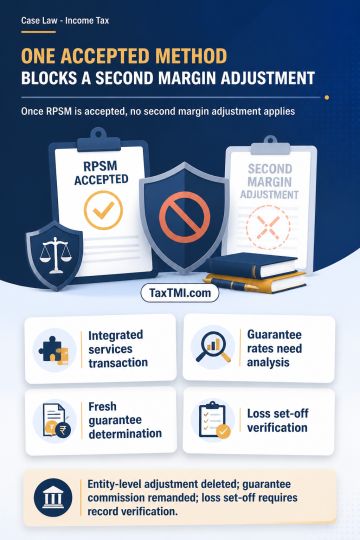
Form 26AS evidence requires successor-entity accounting verification after business transfer, while invoice-supported related-party advertising expend...
Money-laundering judgment timing requires awaiting the scheduled-offence decision despite continuation of the underlying trial where outcomes directly...
Accredited investor eligibility expands through securities-market exposure, while alternative investment fund disputes require prescribed resolution a...
Page of 4916
Press 'Enter' after typing page number.
41 to 60 of 98302 Results
❮
❯
❯❯
0 / 200
Expand Note
Add to Folder
No Folders have been created
+
Are you sure you want to delete "My most important" ?
Justification of upholding the penalty imposed u/s 51(7)(b) for goods imported from an excise duty-exempt state on the ground of undervaluation based on MRP provisions under the Central Excise Act. The court held that the invoices were issued by the manufacturer in the excise duty-exempt state, leading to a lower purchase price. Merely because the MRP was higher, it cannot be presumed that the invoices were undervalued. The dealer would further sell the goods to distributors, and a lower sale price does not necessarily imply tax evasion. Imposing a penalty based on such presumption would be an exercise of arbitrary power. Additionally, the court ruled that the power to impose penalties u/s 51(7)(b) should be exercised by the assessing authority after determining the actual valuation, not during roadside checking. The questions were answered in favor of the assessee.
Justification of upholding the penalty imposed u/s 51(7)(b) for goods imported from an excise duty-exempt state on the ground of undervaluation based on MRP provisions under the Central Excise Act. The court held that the invoices were issued by the manufacturer in the excise duty-exempt state, leading to a lower purchase price. Merely because the MRP was higher, it cannot be presumed that the invoices were undervalued. The dealer would further sell the goods to distributors, and a lower sale price does not necessarily imply tax evasion. Imposing a penalty based on such presumption would be an exercise of arbitrary power. Additionally, the court ruled that the power to impose penalties u/s 51(7)(b) should be exercised by the assessing authority after determining the actual valuation, not during roadside checking. The questions were answered in favor of the assessee.
Note: It is a system-generated summary and is for quick reference only.
 TaxTMI
 TaxTMI

 of 4916