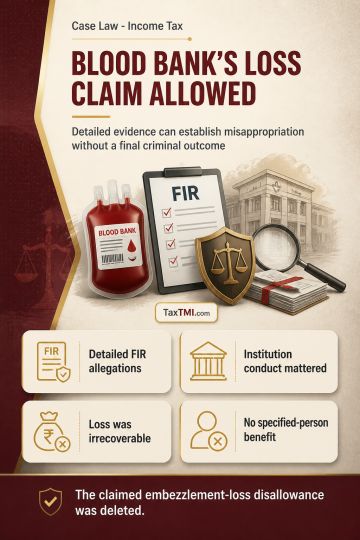
Embezzlement losses in charitable institutions remain allowable when misappropriation is established, irrecoverable, and not a specified-person benefi...
National long-distance undertaking status supports deduction where separately licensed infrastructure, resources, revenue, and expenditure establish c...
Agency reimbursement income follows contractual deposit-liability computation, while pending deposit collections do not constitute deemed-dividend loa...
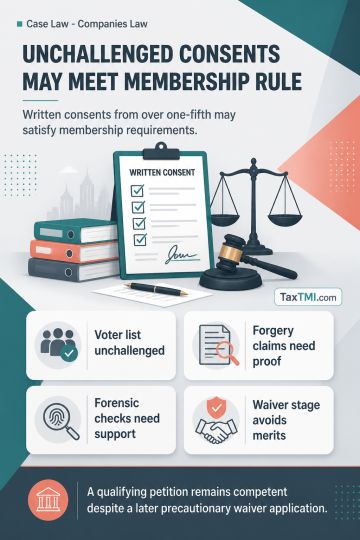
Membership-consent thresholds for oppression petitions are satisfied by unchallenged voter-list consents, while unsupported forgery claims require pro...
The Supreme Court quashed the summoning order issued for offences u/ss 406, 420 and 120B of the Indian Penal Code, 1860, emphasizing the non-application of mind by the lower courts. It clarified the distinction between criminal breach of trust and cheating, stating that vicarious liability cannot be attributed to office bearers for these offences unless a statutory provision exists. Mere breach of contract or trust does not constitute criminal breach of trust or cheating unless fraudulent intention is proven from inception. In sale of goods, failure to pay consideration cannot amount to criminal breach of trust as the property passes to the purchaser upon delivery. The magistrate and police must carefully apply their mind to ascertain if allegations genuinely constitute these offences before taking cognizance or registering FIR.
The Supreme Court quashed the summoning order issued for offences u/ss 406, 420 and 120B of the Indian Penal Code, 1860, emphasizing the non-application of mind by the lower courts. It clarified the distinction between criminal breach of trust and cheating, stating that vicarious liability cannot be attributed to office bearers for these offences unless a statutory provision exists. Mere breach of contract or trust does not constitute criminal breach of trust or cheating unless fraudulent intention is proven from inception. In sale of goods, failure to pay consideration cannot amount to criminal breach of trust as the property passes to the purchaser upon delivery. The magistrate and police must carefully apply their mind to ascertain if allegations genuinely constitute these offences before taking cognizance or registering FIR.
Note: It is a system-generated summary and is for quick reference only.
 TaxTMI
  TaxTMI
 of 4881