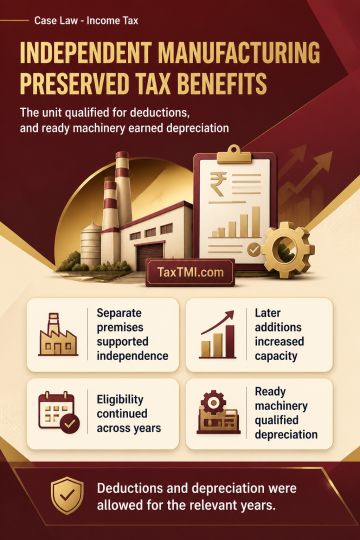
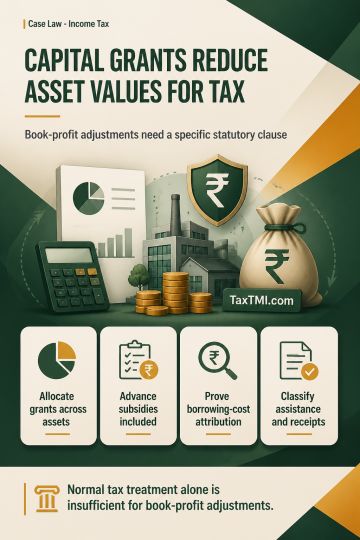
Independent manufacturing undertaking eligibility preserves Section 80IA/80IB deductions, while machinery kept ready for use qualifies for depreciatio...
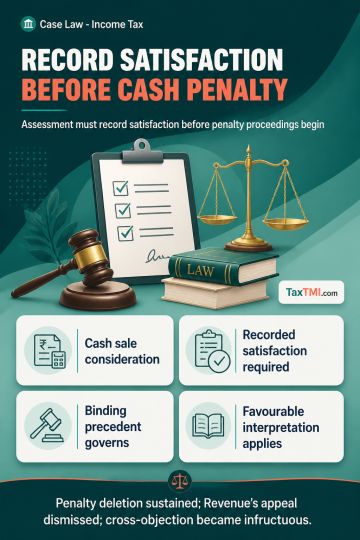
Assessing Officer Satisfaction Requirement Bars Penalty for Cash Receipt in Immovable-Property Sale Cases Where Initiation Lacks Recorded Satisfaction...
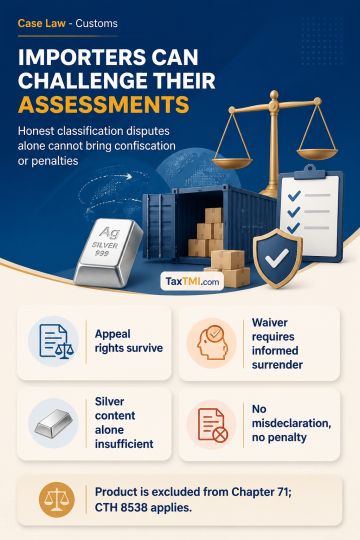
Self-assessed import entries remain appealable, while bona fide classification disputes without misdeclaration cannot justify confiscation or penaltie...
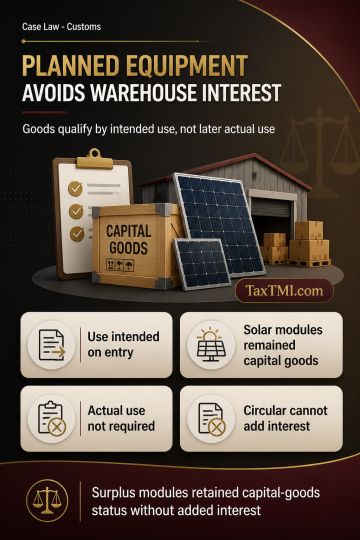
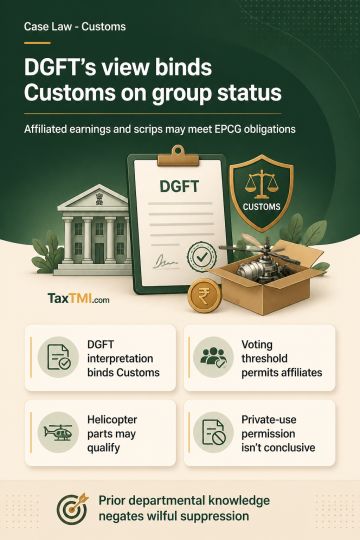
Actual-user customs exemption conditions permit turnkey project transfers when imported windmill components are exclusively used for installation and ...
Customs offence disqualification excludes civil contraventions, preventing refusal of a private bonded warehouse licence based solely on monetary pena...
A bail application was rejected in a case involving the creation of fake companies, appointment of fictitious directors/ partners/ proprietors, and illegal passing of inadmissible Input Tax Credit under the Goods and Services Tax (GST) laws. The accused, without the knowledge of the purported directors/staff, utilized invoices from fictitious suppliers to wrongfully avail and pass on ineligible Input Tax Credit, resulting in substantial revenue loss to the government. The court emphasized that economic offenses involving deep-rooted conspiracies and massive public fund losses should be viewed seriously as grave offenses affecting the nation's economy. Citing a Supreme Court precedent, the court held that such white-collar criminals, driven by personal profit motives and impeding national development through calculated dishonesty, warrant a different approach to bail. Considering the allegations, verified materials, and the cognizance order for offenses under GST laws and the Indian Penal Code, the court rejected the bail application.
A bail application was rejected in a case involving the creation of fake companies, appointment of fictitious directors/ partners/ proprietors, and illegal passing of inadmissible Input Tax Credit under the Goods and Services Tax (GST) laws. The accused, without the knowledge of the purported directors/staff, utilized invoices from fictitious suppliers to wrongfully avail and pass on ineligible Input Tax Credit, resulting in substantial revenue loss to the government. The court emphasized that economic offenses involving deep-rooted conspiracies and massive public fund losses should be viewed seriously as grave offenses affecting the nation's economy. Citing a Supreme Court precedent, the court held that such white-collar criminals, driven by personal profit motives and impeding national development through calculated dishonesty, warrant a different approach to bail. Considering the allegations, verified materials, and the cognizance order for offenses under GST laws and the Indian Penal Code, the court rejected the bail application.
Note: It is a system-generated summary and is for quick reference only.
 TaxTMI
  TaxTMI
 of 4891