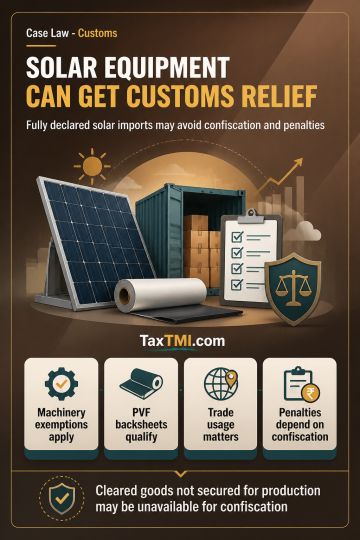
Customs exemptions cover photovoltaic assembly machinery and PVF backsheets, while fully declared cleared imports may avoid confiscation and penalties...
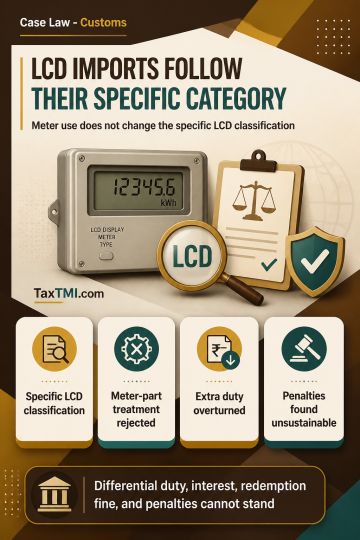
Specific tariff classification for LCD devices overrides treatment as electricity-meter parts, defeating differential duty, extended limitation, and p...
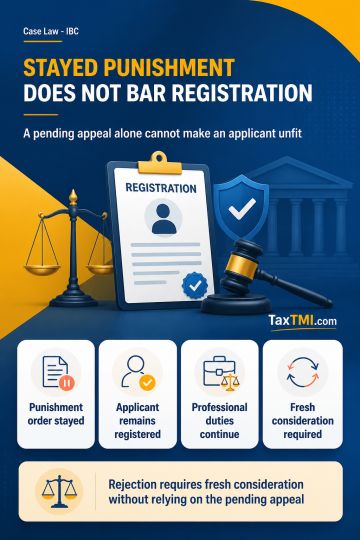
Stayed disciplinary punishment does not establish unfitness for insolvency professional registration; reconsideration must disregard mere pendency of ...
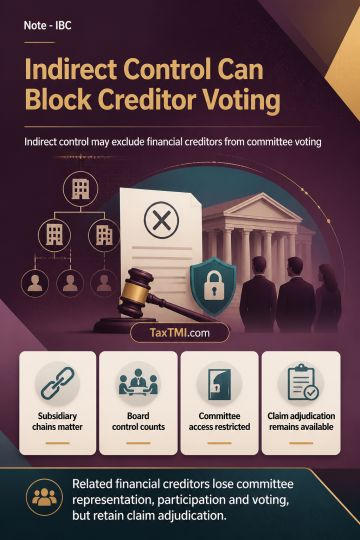
Indirect corporate control can create related-party status, excluding financial creditors from Committee of Creditors representation, participation an...
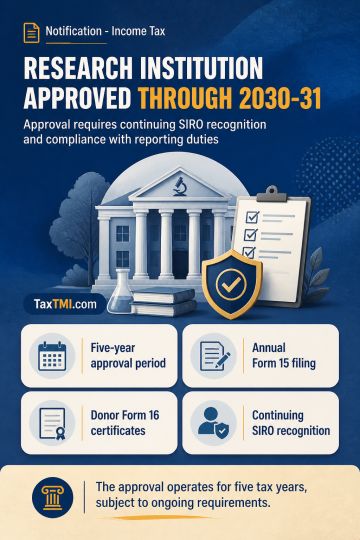
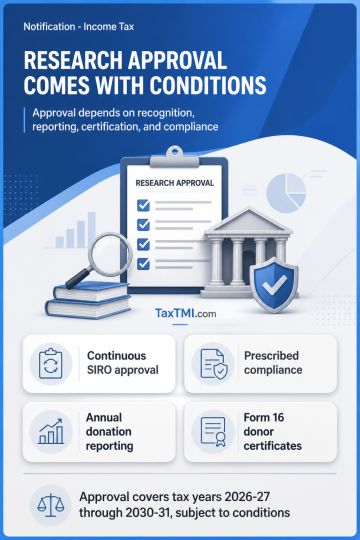
Scientific research association approval requires continuing SIRO status, annual donation reporting, and donor certificates for the approved foundatio...
Scientific research institution approval is conditional on SIRO recognition, annual donation reporting, donor certification, and prescribed compliance...
The case deals with the levy of service tax on 'indent commission' received by an Indian company from its overseas holding company for providing business auxiliary services. The judgments of the Delhi High Court in Verizon Communication India Pvt. Ltd. and the Larger Bench of CESTAT in Paul Merchants Limited were analyzed. It was observed that the Indian company provided necessary details of customers in India to foreign steel mills, enabling them to execute contracts directly with Indian customers. The Indian company satisfied the conditions of the Export of Service Rules, 2005, as payments were received in convertible foreign exchange. Applying the principles laid down in the cited cases, it was held that the services rendered by the appellant to its holding company fell within the scope of the Export of Service Rules, 2005. Consequently, the demand for service tax could not be sustained, and the impugned orders were set aside.
The case deals with the levy of service tax on 'indent commission' received by an Indian company from its overseas holding company for providing business auxiliary services. The judgments of the Delhi High Court in Verizon Communication India Pvt. Ltd. and the Larger Bench of CESTAT in Paul Merchants Limited were analyzed. It was observed that the Indian company provided necessary details of customers in India to foreign steel mills, enabling them to execute contracts directly with Indian customers. The Indian company satisfied the conditions of the Export of Service Rules, 2005, as payments were received in convertible foreign exchange. Applying the principles laid down in the cited cases, it was held that the services rendered by the appellant to its holding company fell within the scope of the Export of Service Rules, 2005. Consequently, the demand for service tax could not be sustained, and the impugned orders were set aside.
Note: It is a system-generated summary and is for quick reference only.
 TaxTMI
  TaxTMI
 of 4879