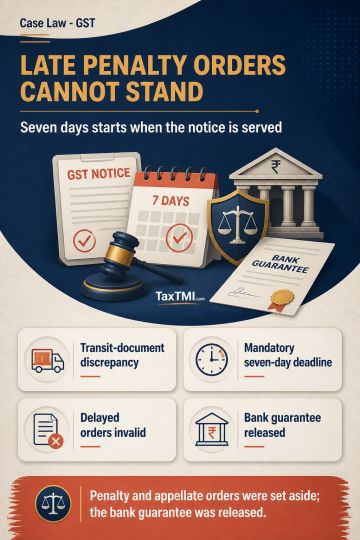
Coercive recovery during GST searches is restrained pending scrutiny, preserving normal business operations and requiring adherence to investigation g...
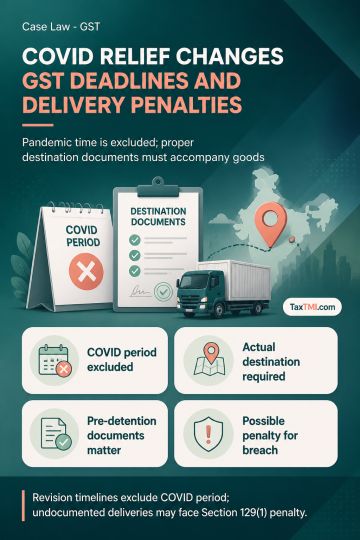
COVID-19 limitation exclusion and destination-specific e-way bills govern revisional timelines and penalties for undocumented third-party plywood deli...
Questions arising from miscellaneous application orders cannot challenge unaltered Tribunal findings, leaving the original order separately challengea...
Transfer-pricing comparability filters require fresh arm's-length analysis, while delayed receivables need separate reconsideration with working-capit...
Page of 4894
Press 'Enter' after typing page number.
721 to 740 of 97867 Results
❮
❯
❯❯
0 / 200
Expand Note
Add to Folder
No Folders have been created
+
Are you sure you want to delete "My most important" ?
The case involved a dispute regarding the dishonour of cheques, with the key issue being whether the Respondent had a legal obligation to pay back the money under the cheques. The Appellate Court considered the scope of interference in a judgment acquitting the accused and the statutory presumptions u/ss 138 and 139 of the NI Act. The Respondent admitted executing promissory notes and cheques which were later dishonoured. The Court noted that the presumption u/s 139 could be rebutted by the accused with a defense based on a preponderance of probabilities. The Respondent successfully rebutted the presumption by raising doubts about the Petitioner's claims, shifting the burden of proof. The Petitioner failed to discharge this burden, leading to the Respondent's acquittal u/s 138 of the NI Act. The petition seeking leave to appeal was dismissed by the High Court.
The case involved a dispute regarding the dishonour of cheques, with the key issue being whether the Respondent had a legal obligation to pay back the money under the cheques. The Appellate Court considered the scope of interference in a judgment acquitting the accused and the statutory presumptions u/ss 138 and 139 of the NI Act. The Respondent admitted executing promissory notes and cheques which were later dishonoured. The Court noted that the presumption u/s 139 could be rebutted by the accused with a defense based on a preponderance of probabilities. The Respondent successfully rebutted the presumption by raising doubts about the Petitioner's claims, shifting the burden of proof. The Petitioner failed to discharge this burden, leading to the Respondent's acquittal u/s 138 of the NI Act. The petition seeking leave to appeal was dismissed by the High Court.
Note: It is a system-generated summary and is for quick reference only.
 TaxTMI
  TaxTMI
 of 4894