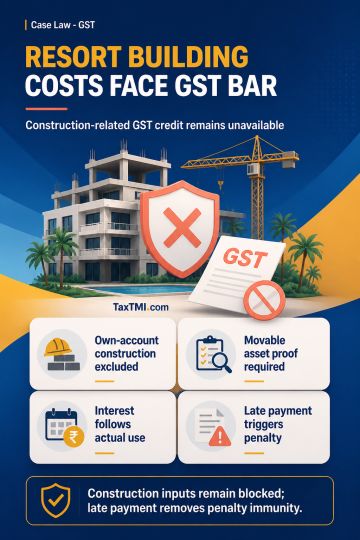
Blocked input tax credit for resort construction remains unavailable; interest follows actual utilisation, while delayed payment attracts statutory pe...
Duplicate PAN allocation requires record verification and deactivation reasons before assessment-related transactions can be attributed to an assessee...
Faceless assessment safeguards require requested personal hearings and adequate final show-cause response time, failing which reassessment is required...
The assessee, an NRI and resident of USA, transferred a capital asset and derived capital gain. The asset comprised rights and interests acquired through an assignment deed executed in USA. The Assessing Officer treated the gain as short-term, restricting the holding period to less than 24 months based on an employment agreement. However, the Tribunal held that since no shares were delivered to the assessee, the capital asset did not qualify as shares/securities of an Indian company u/s 2(42A). As the asset was held for less than 36 months, it was rightly treated as short-term. Regarding taxability in India u/s 9(1)(i), the Tribunal held that the situs of the capital asset was in USA, where the assignment deed was executed, and the termination agreement specified California courts' jurisdiction. Therefore, the capital gain derived from transfer of the asset situated outside India was not taxable in India. However, as the assessee had voluntarily filed a return offering the gain as long-term, the Tribunal directed the AO to accept the capital gain offered in the return.
The assessee, an NRI and resident of USA, transferred a capital asset and derived capital gain. The asset comprised rights and interests acquired through an assignment deed executed in USA. The Assessing Officer treated the gain as short-term, restricting the holding period to less than 24 months based on an employment agreement. However, the Tribunal held that since no shares were delivered to the assessee, the capital asset did not qualify as shares/securities of an Indian company u/s 2(42A). As the asset was held for less than 36 months, it was rightly treated as short-term. Regarding taxability in India u/s 9(1)(i), the Tribunal held that the situs of the capital asset was in USA, where the assignment deed was executed, and the termination agreement specified California courts' jurisdiction. Therefore, the capital gain derived from transfer of the asset situated outside India was not taxable in India. However, as the assessee had voluntarily filed a return offering the gain as long-term, the Tribunal directed the AO to accept the capital gain offered in the return.
Note: It is a system-generated summary and is for quick reference only.
 TaxTMI
  TaxTMI
 of 4888