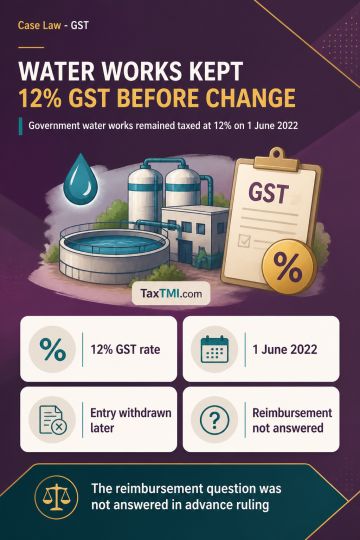
Government water works contract GST concession applied before its withdrawal, while contractual tax reimbursement claims lay outside advance-ruling sc...
Stamp valuation increases after registration-fee payment led to deletion of property-purchase addition within tolerance and without valuation referral...
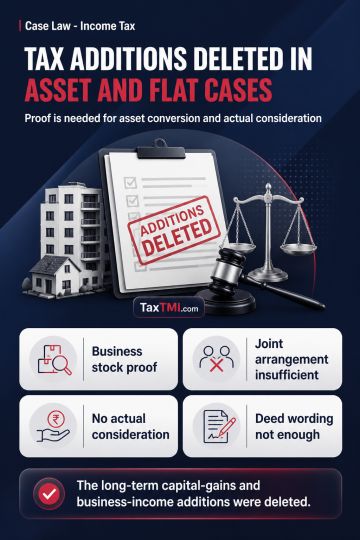
Capital Asset Conversion Requires Proven Business Stock Treatment; Paper Consideration in Spousal Flat Transfers Does Not Create Taxable Business Inco...
Page of 4881
Press 'Enter' after typing page number.
341 to 360 of 97618 Results
❮
❯
❯❯
0 / 200
Expand Note
Add to Folder
No Folders have been created
+
Are you sure you want to delete "My most important" ?
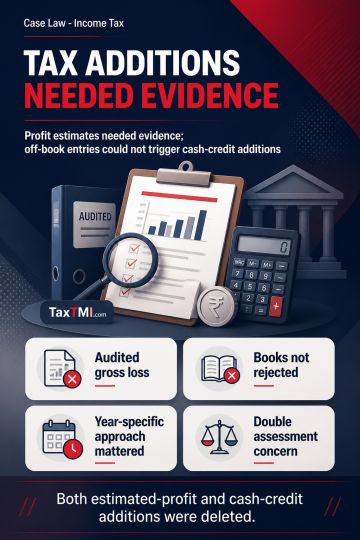
The assessee's appeal was allowed and the addition was deleted. The authorities failed to analyze the assessee's specific stand and incorrectly assumed availability of unexplained cash credit. The AO's findings regarding abnormal cash deposit trend during demonetization and earlier months were incorrect, as demonstrated by the assessee's tabulated details showing gradual increase in turnover. The AO did not visualize the circumstances during demonetization, where all amounts had to be routed through bank accounts. The CIT(A) reduced the quantum addition but adopted a different analogy, calculating cash availability based on turnover increase without analyzing purchases and resulting profit. The ITAT held that the addition was unsustainable, as the authorities did not examine whether the profit ratio could be swindled to that magnitude, and books of account should not have been rejected.
The assessee's appeal was allowed and the addition was deleted. The authorities failed to analyze the assessee's specific stand and incorrectly assumed availability of unexplained cash credit. The AO's findings regarding abnormal cash deposit trend during demonetization and earlier months were incorrect, as demonstrated by the assessee's tabulated details showing gradual increase in turnover. The AO did not visualize the circumstances during demonetization, where all amounts had to be routed through bank accounts. The CIT(A) reduced the quantum addition but adopted a different analogy, calculating cash availability based on turnover increase without analyzing purchases and resulting profit. The ITAT held that the addition was unsustainable, as the authorities did not examine whether the profit ratio could be swindled to that magnitude, and books of account should not have been rejected.
Note: It is a system-generated summary and is for quick reference only.
 TaxTMI
  TaxTMI
 of 4881