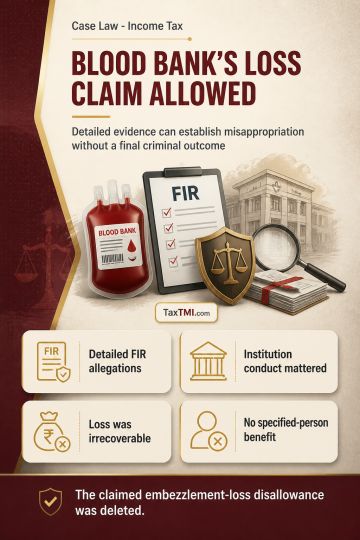
Embezzlement losses in charitable institutions remain allowable when misappropriation is established, irrecoverable, and not a specified-person benefi...
National long-distance undertaking status supports deduction where separately licensed infrastructure, resources, revenue, and expenditure establish c...
Agency reimbursement income follows contractual deposit-liability computation, while pending deposit collections do not constitute deemed-dividend loa...
Membership-consent thresholds for oppression petitions are satisfied by unchallenged voter-list consents, while unsupported forgery claims require pro...
Consultancy charges paid to a director were disallowed u/s 40A(2). The assessee justified the payment, citing the director's expertise, experience, and reasonableness compared to the business size. The ITAT held that the AO cannot judge the expenditure's reasonableness unless proven excessive compared to market rates. The Madras High Court ruled that expenditure reasonableness must be judged from a businessman's viewpoint, not Revenue's, unless excessive payment is proven. The assessee's project started generating revenue, justifying the increased payment. The payment complied with the Companies Act, TDS was deducted, and the director offered it for tax. The AO failed to demonstrate the payment's excessiveness or unreasonableness. Merely disallowing the differential without establishing unreasonableness was incorrect. The disallowance was deleted in favor of the assessee.
Consultancy charges paid to a director were disallowed u/s 40A(2). The assessee justified the payment, citing the director's expertise, experience, and reasonableness compared to the business size. The ITAT held that the AO cannot judge the expenditure's reasonableness unless proven excessive compared to market rates. The Madras High Court ruled that expenditure reasonableness must be judged from a businessman's viewpoint, not Revenue's, unless excessive payment is proven. The assessee's project started generating revenue, justifying the increased payment. The payment complied with the Companies Act, TDS was deducted, and the director offered it for tax. The AO failed to demonstrate the payment's excessiveness or unreasonableness. Merely disallowing the differential without establishing unreasonableness was incorrect. The disallowance was deleted in favor of the assessee.
Note: It is a system-generated summary and is for quick reference only.
 TaxTMI
  TaxTMI
 of 4881