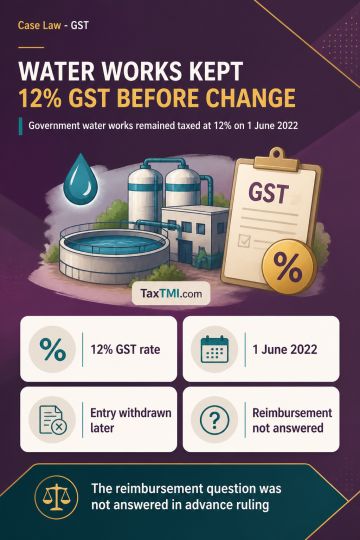
Government water works contract GST concession applied before its withdrawal, while contractual tax reimbursement claims lay outside advance-ruling sc...
Stamp valuation increases after registration-fee payment led to deletion of property-purchase addition within tolerance and without valuation referral...
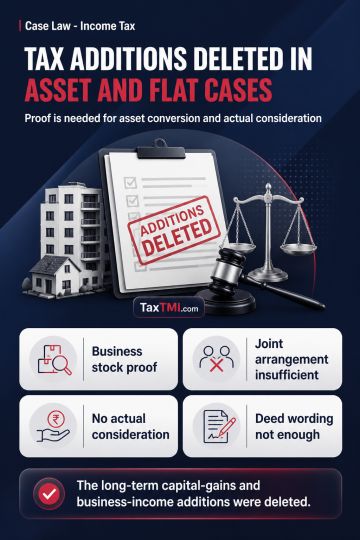
Capital Asset Conversion Requires Proven Business Stock Treatment; Paper Consideration in Spousal Flat Transfers Does Not Create Taxable Business Inco...
Page of 4881
Press 'Enter' after typing page number.
341 to 360 of 97618 Results
❮
❯
❯❯
0 / 200
Expand Note
Add to Folder
No Folders have been created
+
Are you sure you want to delete "My most important" ?
Reassessment proceedings were held invalid due to lack of proper jurisdiction by the Assistant Commissioner of Income Tax while issuing the notice u/s 148. The assessment order was not passed by the person issuing the notice, rendering it a curable defect u/s 292BB. The ACIT lacked pecuniary jurisdiction as the assessee's total income for the relevant assessment year fell within the Income Tax Officer's jurisdiction. The subsequent transfer of assessment records by the ACIT to the ITO was deemed illegal, as transfers can only be done u/s 127 of the Income Tax Act, 1961. The defect was deemed incurable and not amenable to correction u/s 292BB. Consequently, the notice issued u/s 148 was without jurisdiction, and the consequent assessment order was held invalid. The Appellate Tribunal ruled in favor of the assessee, aligning with the Bombay High Court's judgment in Ashok Devichand Jain v. Union of India & Ors.
Reassessment proceedings were held invalid due to lack of proper jurisdiction by the Assistant Commissioner of Income Tax while issuing the notice u/s 148. The assessment order was not passed by the person issuing the notice, rendering it a curable defect u/s 292BB. The ACIT lacked pecuniary jurisdiction as the assessee's total income for the relevant assessment year fell within the Income Tax Officer's jurisdiction. The subsequent transfer of assessment records by the ACIT to the ITO was deemed illegal, as transfers can only be done u/s 127 of the Income Tax Act, 1961. The defect was deemed incurable and not amenable to correction u/s 292BB. Consequently, the notice issued u/s 148 was without jurisdiction, and the consequent assessment order was held invalid. The Appellate Tribunal ruled in favor of the assessee, aligning with the Bombay High Court's judgment in Ashok Devichand Jain v. Union of India & Ors.
Note: It is a system-generated summary and is for quick reference only.
 TaxTMI
  TaxTMI
 of 4881