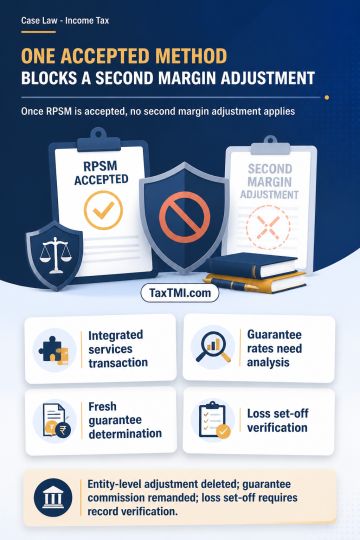
Form 26AS evidence requires successor-entity accounting verification after business transfer, while invoice-supported related-party advertising expend...
Money-laundering judgment timing requires awaiting the scheduled-offence decision despite continuation of the underlying trial where outcomes directly...
Accredited investor eligibility expands through securities-market exposure, while alternative investment fund disputes require prescribed resolution a...
Page of 4916
Press 'Enter' after typing page number.
41 to 60 of 98302 Results
❮
❯
❯❯
0 / 200
Expand Note
Add to Folder
No Folders have been created
+
Are you sure you want to delete "My most important" ?
The Appellate Tribunal addressed issues related to assessment u/ss 153A and 153C, emphasizing the necessity of incriminating material for additions. Following legal precedents, the Tribunal held that in the absence of such material, additions made by the Assessing Officer in an unabated assessment must be quashed. Additionally, the Tribunal ruled against an addition u/s 69C for bogus purchases, noting the capital nature of the expenditure and the purchases' relevance to a different financial year. It further clarified that sections 68 and 69C were inapplicable as the case pertained to expenditure, not unexplained credits. The Tribunal criticized the CIT(A) for broadening the charge without providing the assessee an opportunity to respond, leading to the allowance of the assessee's appeal.
The Appellate Tribunal addressed issues related to assessment u/ss 153A and 153C, emphasizing the necessity of incriminating material for additions. Following legal precedents, the Tribunal held that in the absence of such material, additions made by the Assessing Officer in an unabated assessment must be quashed. Additionally, the Tribunal ruled against an addition u/s 69C for bogus purchases, noting the capital nature of the expenditure and the purchases' relevance to a different financial year. It further clarified that sections 68 and 69C were inapplicable as the case pertained to expenditure, not unexplained credits. The Tribunal criticized the CIT(A) for broadening the charge without providing the assessee an opportunity to respond, leading to the allowance of the assessee's appeal.
Note: It is a system-generated summary and is for quick reference only.
 TaxTMI
 TaxTMI

 of 4916