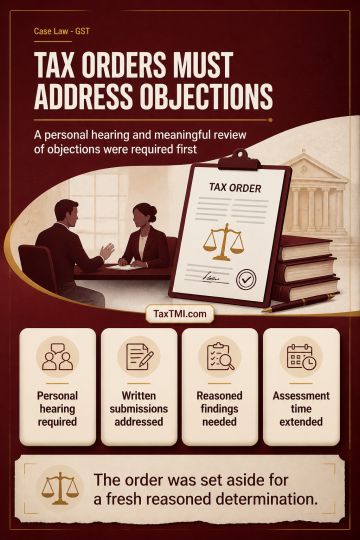
The High Court examined the validity of an assessment order issued without offering a personal hearing, deeming it a breach of natural justice. The case was transferred from the National Faceless Assessment Center to the jurisdictional AO u/s 144B(8). The respondent rejected the petitioner's request for a hearing via video conference due to purported lack of functionality, contrary to provisions in section 144B and a CBDT circular. The court found the respondent's claim baseless as the circular mandated a hearing either via video conference or in a designated area. The petitioner's right to a hearing was upheld, dismissing the respondent's argument of alternative appeal options. The assessment order was annulled, and the matter was remanded for a proper hearing in line with the CBDT circular.
The High Court examined the validity of an assessment order issued without offering a personal hearing, deeming it a breach of natural justice. The case was transferred from the National Faceless Assessment Center to the jurisdictional AO u/s 144B(8). The respondent rejected the petitioner's request for a hearing via video conference due to purported lack of functionality, contrary to provisions in section 144B and a CBDT circular. The court found the respondent's claim baseless as the circular mandated a hearing either via video conference or in a designated area. The petitioner's right to a hearing was upheld, dismissing the respondent's argument of alternative appeal options. The assessment order was annulled, and the matter was remanded for a proper hearing in line with the CBDT circular.
Note: It is a system-generated summary and is for quick reference only.
 TaxTMI
  TaxTMI
 of 4894