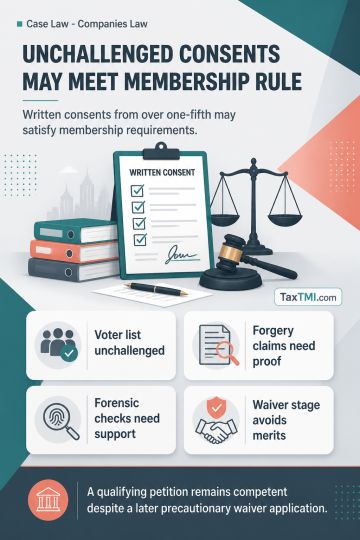
Membership-consent thresholds for oppression petitions are satisfied by unchallenged voter-list consents, while unsupported forgery claims require pro...
The High Court addressed the issue of linking services provided by a company to its separate registered units for taxation purposes under CENVAT Credit Rules. The court clarified that u/r 7, a manufacturer can distribute service tax credits among its units, subject to certain limitations. The court emphasized that there is no restriction on claiming input service tax paid at one unit for use in another unit. The court also noted that a company's divisions and units are not distinct legal entities. Furthermore, the court ruled that once a decision has been accepted by the department in a similar case, the issue cannot be re-litigated. The court highlighted that no provision allowed the issuance of a show cause notice for duty wrongly availed if it was rectified before the notice. Ultimately, the court dismissed the Revenue's appeal.
The High Court addressed the issue of linking services provided by a company to its separate registered units for taxation purposes under CENVAT Credit Rules. The court clarified that u/r 7, a manufacturer can distribute service tax credits among its units, subject to certain limitations. The court emphasized that there is no restriction on claiming input service tax paid at one unit for use in another unit. The court also noted that a company's divisions and units are not distinct legal entities. Furthermore, the court ruled that once a decision has been accepted by the department in a similar case, the issue cannot be re-litigated. The court highlighted that no provision allowed the issuance of a show cause notice for duty wrongly availed if it was rectified before the notice. Ultimately, the court dismissed the Revenue's appeal.
Note: It is a system-generated summary and is for quick reference only.
 TaxTMI
  TaxTMI
 of 4883