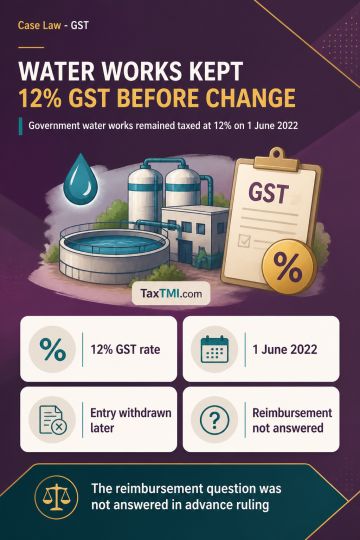
Government water works contract GST concession applied before its withdrawal, while contractual tax reimbursement claims lay outside advance-ruling sc...
Page of 4888
Press 'Enter' after typing page number.
461 to 480 of 97755 Results
❮
❯
❯❯
0 / 200
Expand Note
Add to Folder
No Folders have been created
+
Are you sure you want to delete "My most important" ?
The case involved a dispute regarding the refund of Cenvat duty on education cess and secondary & higher education cess. The appellant, registered in Jammu & Kashmir, availed area-based exemption under Notification No. 56/2002-CE. The issue was whether education cess and S&H education cess paid through Cenvat Credit account could be refunded. The Supreme Court precedent clarified that exemptions must be explicitly stated in notifications. The tribunal found the rejection of a portion of the refund valid but held that appropriation of a specific amount without notice or hearing was improper. The appeal was partially allowed, with the rejection of a refund amount upheld but the appropriation set aside.
The case involved a dispute regarding the refund of Cenvat duty on education cess and secondary & higher education cess. The appellant, registered in Jammu & Kashmir, availed area-based exemption under Notification No. 56/2002-CE. The issue was whether education cess and S&H education cess paid through Cenvat Credit account could be refunded. The Supreme Court precedent clarified that exemptions must be explicitly stated in notifications. The tribunal found the rejection of a portion of the refund valid but held that appropriation of a specific amount without notice or hearing was improper. The appeal was partially allowed, with the rejection of a refund amount upheld but the appropriation set aside.
Note: It is a system-generated summary and is for quick reference only.
 TaxTMI
  TaxTMI
 of 4888