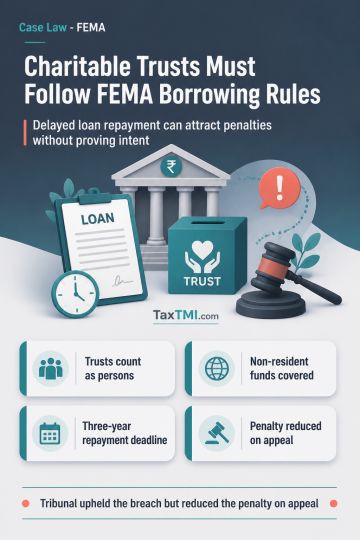
FEMA borrowing restrictions bind charitable trusts, and civil penalties apply without proving intent for delayed repayment of non-resident rupee loans...
The case involved the legality of assessment u/s 153A vs. 153C...
ITAT ruled assessment u/s 153A invalid as based on third-party material, required under u/s 153C. No incriminating material found, additions not valid.
Contents
Summary
Note
Bookmark
Share
✓ Copied successfully !
Print
Print Options
For full text, please login
Login to TaxTMI
Verification Pending
The Email Id has not been verified. Click on the link we have sent on
The case involved the legality of assessment u/s 153A vs. 153C based on materials found during a search of a third party. It was held that assessment u/s 153A cannot be based on materials found during a third-party search; instead, proceedings must be initiated u/s 153C with proper satisfaction recorded by the assessing officers of both parties. Without this satisfaction, no additions can be made. The High Court ruled that additions based on statements from a third party are impermissible u/s 153A. The assessment was deemed bad-in-law due to these procedural lapses. Regarding the addition of undisclosed income, the CIT(A) found factual discrepancies and lack of corroborative evidence, leading to the dismissal of the revenue's appeal.
The case involved the legality of assessment u/s 153A vs. 153C based on materials found during a search of a third party. It was held that assessment u/s 153A cannot be based on materials found during a third-party search; instead, proceedings must be initiated u/s 153C with proper satisfaction recorded by the assessing officers of both parties. Without this satisfaction, no additions can be made. The High Court ruled that additions based on statements from a third party are impermissible u/s 153A. The assessment was deemed bad-in-law due to these procedural lapses. Regarding the addition of undisclosed income, the CIT(A) found factual discrepancies and lack of corroborative evidence, leading to the dismissal of the revenue's appeal.
Note: It is a system-generated summary and is for quick reference only.
 TaxTMI
  TaxTMI
 of 4894