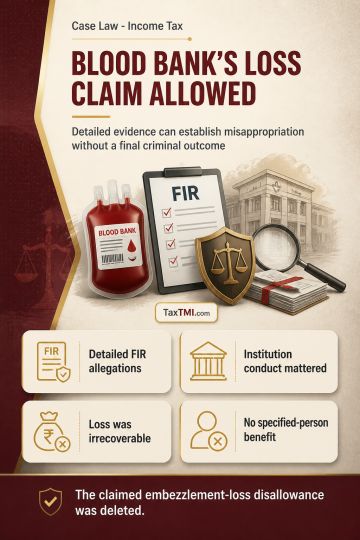
Embezzlement losses in charitable institutions remain allowable when misappropriation is established, irrecoverable, and not a specified-person benefi...
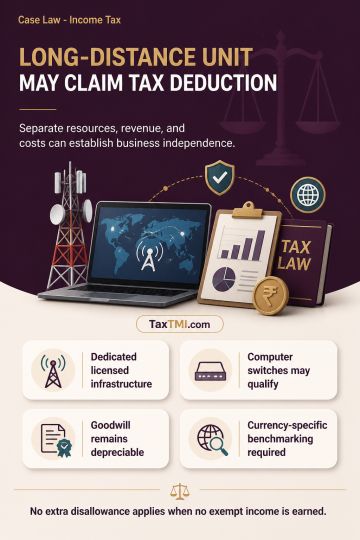
National long-distance undertaking status supports deduction where separately licensed infrastructure, resources, revenue, and expenditure establish c...
Agency reimbursement income follows contractual deposit-liability computation, while pending deposit collections do not constitute deemed-dividend loa...
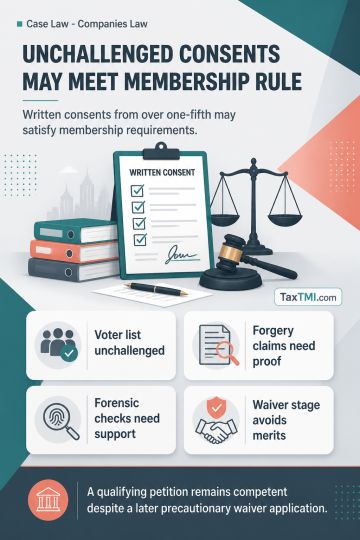
Membership-consent thresholds for oppression petitions are satisfied by unchallenged voter-list consents, while unsupported forgery claims require pro...
The Appellate Tribunal considered a case involving rectification u/s 154 related to income from other sources u/s 56(2)(vii)(b). The issue revolved around the variance between sale consideration and stamp duty valuation. The respondent's assessment was initially accepted u/s 143(3) after scrutiny on investments in movable properties. Subsequently, u/s 154 was invoked to apply section 56(2)(vii)(b) on the purchase of immovable property due to a disparity in stamp duty value and actual consideration. The Tribunal noted that the matter of stamp duty valuation was debatable, indicating a change in opinion. It was established that errors requiring extensive reasoning on debatable legal points do not constitute apparent errors. Consequently, the order u/s 154 was annulled, and the Revenue's appeal was dismissed.
The Appellate Tribunal considered a case involving rectification u/s 154 related to income from other sources u/s 56(2)(vii)(b). The issue revolved around the variance between sale consideration and stamp duty valuation. The respondent's assessment was initially accepted u/s 143(3) after scrutiny on investments in movable properties. Subsequently, u/s 154 was invoked to apply section 56(2)(vii)(b) on the purchase of immovable property due to a disparity in stamp duty value and actual consideration. The Tribunal noted that the matter of stamp duty valuation was debatable, indicating a change in opinion. It was established that errors requiring extensive reasoning on debatable legal points do not constitute apparent errors. Consequently, the order u/s 154 was annulled, and the Revenue's appeal was dismissed.
Note: It is a system-generated summary and is for quick reference only.
 TaxTMI
  TaxTMI
 of 4881